
Advice and inspiration
How can I find out the value of an old hand-knotted rug?

The reliable value of an old hand-knotted rug cannot be established from one photograph, family tradition or age alone. A specialist needs to combine structure, materials, drawing, colour, size, condition and documented origin with recent results for genuinely comparable rugs. The same rug may also have a different figure for sale, insurance or an estate.
Your first step should therefore not be searching for the highest online price, but answering a simpler question: what do you need the valuation for? Only then can the appropriate value basis, market and type of report be selected.
First decide which kind of value you need
| Purpose | What the figure usually represents | Important note |
|---|---|---|
| Ordinary sale | A realistic price an informed buyer may pay in the appropriate market | The result depends on sales channel, timing, commission and current demand |
| Auction estimate | A range for the expected hammer price before a particular auction | It is not a sale guarantee; buyer’s premium and seller’s costs are separate |
| Dealer purchase offer | An amount offered for a quick direct purchase | It is below retail because it includes risk, storage, preparation and margin |
| Insurance | The cost of obtaining a reasonably comparable replacement in the relevant market | Replacement value is often higher than the amount achievable in a sale |
| Estate, property division or dispute | A value defined for a specific legal purpose and effective date | A written report from a qualified appraiser is required under local rules |
If someone states only “the rug’s value” without naming the purpose, date and market, the number can be misleading. A professional report should clearly identify the type of value, the effective date, information used and any limiting conditions.
What has the greatest effect on price
Origin and correct attribution
The first task is to determine whether the rug is genuinely hand-knotted and which region, workshop or tradition it may be attributed to. A specialist examines weave structure, knots, warp and weft, materials, finishes, drawing and colour. Pattern alone is not enough: popular Persian and Caucasian compositions have been copied in many countries.
Age and rarity
Greater age can add value when a rug is also authentic, artistically strong, rare and in appropriate condition. An old but common rug with little demand may be worth less than an exceptional piece from a later period. A date woven into a rug must also be interpreted carefully: it can refer to manufacture, a repair, a patron or be part of a later copy.
Materials and technical quality
The examiner considers the type and quality of wool, silk or cotton, the fineness and consistency of the weave, pile height, clarity of the reverse and work at the edges. Knot count is only one piece of evidence. High density does not guarantee value, and fineness may not be the main strength of a bold village or nomadic rug.
Design, colour and artistic quality
Balance, confident drawing, rhythm, motif scale and colour harmony all matter. Collectors may seek a rare palette, unusual format, known workshop or distinctive drawing. Natural tonal change, known as abrash, can be a desirable sign of hand-dyed yarn; chemical fading or harsh recolouring commonly reduces value.
Size and current demand
Size changes the pool of possible buyers. Some dimensions fit modern interiors easily, while others require a very specific space. An exceptionally large carpet does not automatically command more if it is difficult to display, store and transport. Market preferences also change over time.
Provenance
Receipts, historic interior photographs, inventory records, auction catalogues, exhibition labels or correspondence may support a rug’s history. A family story is a useful lead but not documentary proof by itself. Significant, verifiable provenance can strengthen both confidence in the attribution and buyer interest.
Condition and restoration can decide the result
A specialist considers how much original material survives and whether the rug can be used or displayed safely. The inspection covers low or missing pile, exposed foundation, shortened ends, damaged side edges, holes, splits, stains, odour, mildew, insect activity, uneven fading and distortion.
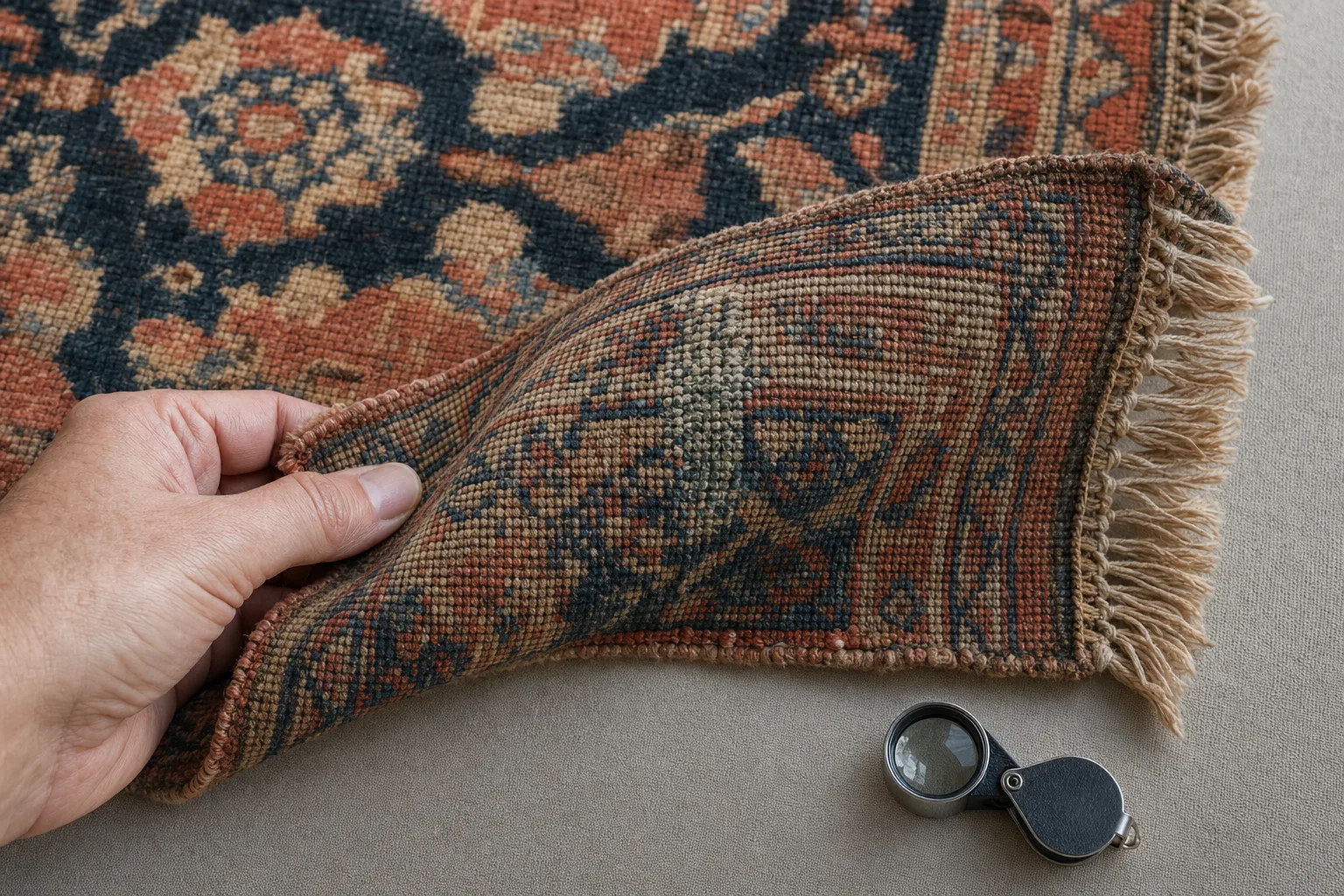
The face reveals colour and wear; the reverse reveals construction and repairs. A meaningful valuation needs both sides, edges and fringe.
Restoration is not automatically negative. On a very old and rare rug, a skilled historic repair may be acceptable and professional conservation can prevent further loss. Extensive replacement, insensitive reweaving, chemical washing, clipping, painted colour or reduction in size can, however, materially affect authenticity, appearance and market value.
How to prepare for an initial consultation
Good photographs help a specialist decide whether an in-person examination is worthwhile, but they do not replace a complete appraisal. Photograph the rug in neutral daylight without filters or automatic colour enhancement.
- the entire face square-on from above, without furniture or strong perspective distortion,
- the full reverse or a large clearly readable section,
- a close view of knots on the reverse with an ordinary scale beside the rug,
- both ends, fringe and both side edges,
- the most worn area, every stain, hole and repair,
- any inscriptions, labels, stamps or inventory numbers,
- a colour detail of the pile viewed from both directions, because pile direction changes its apparent shade.
Measure the length and width of the knotted area, recording fringe separately. Write down what you genuinely know: when and where the rug was obtained, who owned it, and whether it has been cleaned, repaired, stored or exposed to strong sunlight. Mark uncertain information as family belief rather than fact.
Why an online asking price is not evidence of value
An asking price shows what a seller hopes to receive, not what the market has accepted. Verified completed sales are more useful, but they still require careful comparison. A similar regional name is not enough if age, material, size, drawing quality, condition, provenance or sale date differs.
An auction hammer price is also not the same as the total paid by the buyer or the net amount received by the seller. When comparing results, check whether the published number includes buyer’s premium, taxes, shipping, insurance and seller’s commission.
What not to do before valuation
- do not wash the rug at home or chemically “brighten” it,
- do not cut damaged fringe or straighten uneven ends,
- do not conceal holes with adhesive backing or an amateur patch,
- do not recolour faded areas with marker, paint or tint,
- do not discard old receipts, labels, wrapping or photographs,
- do not fold the rug sharply; roll it loosely and protect it from moisture.
Work carried out before examination can remove evidence or cost more than it adds in value. Identify the rug’s condition and significance first, then decide on cleaning, stabilisation or restoration with a specialist.
When an informal opinion is enough and when you need a report
For an initial decision about whether a rug deserves further research, a preliminary opinion from good photographs may be sufficient. Before selling a potentially valuable piece, an in-person inspection and current market comparison are appropriate. For insurance, estates, divorce settlement, donation or litigation, request a written report from a qualified independent appraiser using the correctly defined type of value.
The appraiser should explain their rug expertise, scope of inspection, relevant market, comparable sales and any uncertainty. A dealer’s purchase offer and an independent appraisal are not the same: one proposes a commercial transaction, while the other should provide a reasoned opinion for a defined purpose.
A practical five-step process
- Decide whether you need sale, auction, insurance or legal value.
- Prepare clear photographs, exact measurements and all provenance documents.
- Ask a specialist whether an in-person examination is necessary.
- Before cleaning or repair, obtain advice and a proposed treatment cost.
- For a formal purpose, request a dated written report with a clear value definition.