
Advice and inspiration
How to identify a quality hand-knotted Persian rug

Counting knots or reading a fibre label is not enough to judge a hand-knotted Persian rug. Quality comes from the relationship between its construction, wool or silk, precision of weave, colours, condition and provenance. A fine city rug may have a very high knot density, while an honest village rug may stand out for resilient wool and bold drawing. Both can be excellent — simply in different ways.
First confirm that the rug is genuinely hand-knotted
Lift a corner and examine the reverse. On a hand-knotted rug, the design remains visible from the back and individual knots can be distinguished at close range. There is no glued latex or rigid fabric layer concealing the construction. The fringes are usually the ends of the warp threads on which the rug was built, rather than decoration sewn onto a finished rug.
A highly regular reverse does not rule out handwork; a skilled weaver can be remarkably precise. The construction itself is what matters. In a hand-tufted rug, yarn is inserted into a foundation cloth and the back is usually secured with adhesive and a covering layer. That is a different technique, not hand-knotting.
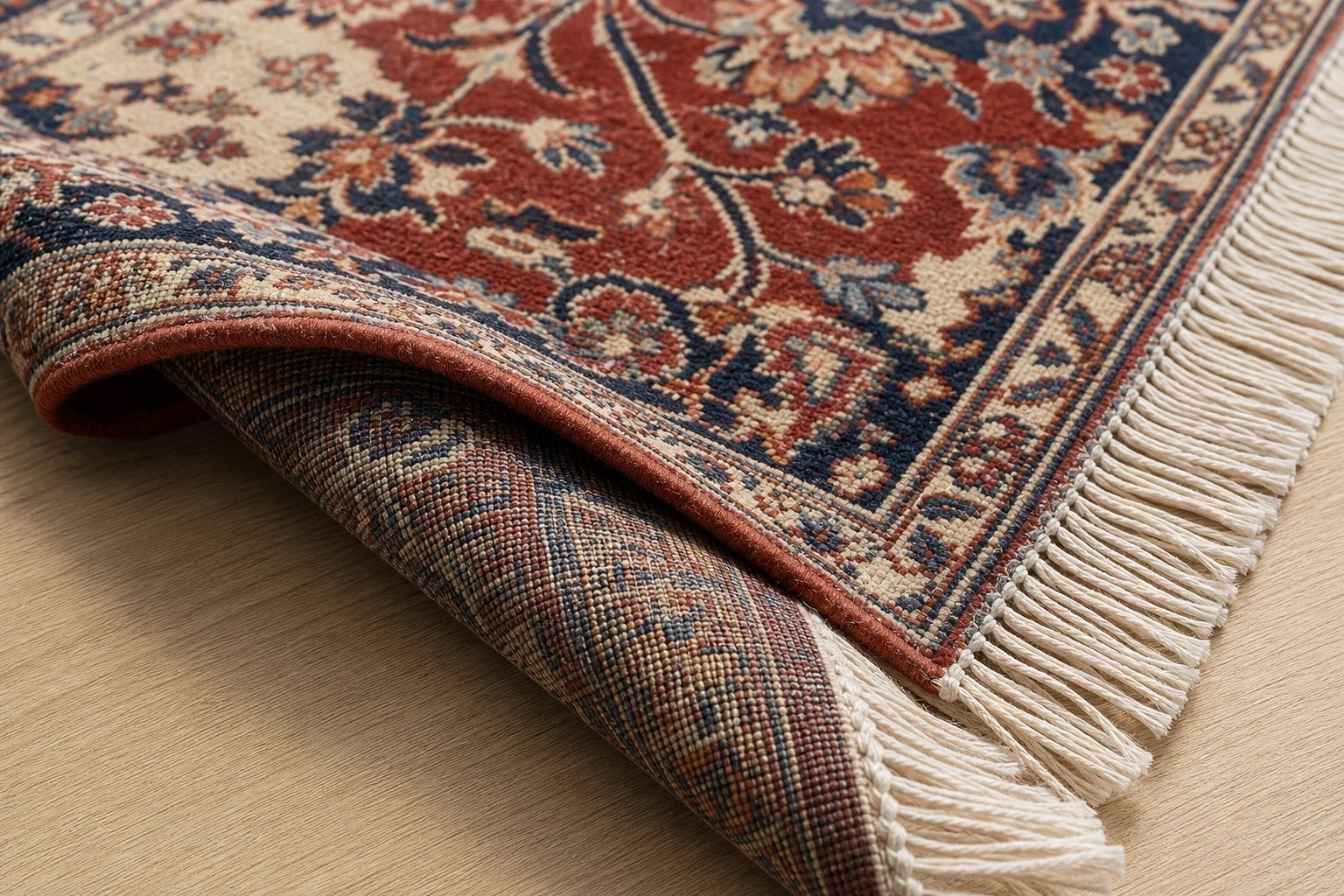
One close view can reveal the pile, the legibility of the reverse, the edge finish and whether the fringe continues from the foundation.
Assess the materials by sight and touch
Good carpet wool is usually resilient and pleasant to the touch, with a natural rather than plastic-looking sheen. When you brush the pile with and against its direction, the colour may change; this is a normal optical characteristic of a pile surface. The fibres should not feel unusually brittle or dry, nor should the pile separate easily from the foundation.
Silk allows exceptionally fine drawing and has a distinctive lustre, but it does not automatically make a rug better or more suitable for every room. A first-rate wool rug may be more practical in a regularly used living room than a very fine silk piece. Ask separately about the pile, warp and weft, as these parts are not necessarily made from the same fibre.
Knot density needs context
A higher knot density enables a weaver to create finer lines, smaller motifs and more accurate curves. It is useful when comparing rugs of the same origin, material and type, but it is not a universal quality ranking. A robust geometric rug with fewer knots may have superb wool, a strong structure and a long working life, while a densely knotted rug can still be made from mediocre materials.
Treat knot count as a technical specification, not a score out of ten. Look at whether the density suits the design and whether the knots are secure and reasonably even. A reputable seller should be able to explain the figure and how it was calculated.
Check the workmanship
- Pile: it should be clipped reasonably evenly and have no unexplained bald areas. On an older rug, a lower pile may be the natural result of use rather than a defect in itself.
- Edges: side bindings should be secure, without loose threads or fresh adhesive.
- Shape: the rug should rest calmly on a level floor. Small variations are natural in handwork, but pronounced rippling, bulges or a severely skewed shape require an explanation.
- Drawing: the design should be legible and balanced. Subtle irregularities give handwork character; broken lines or sudden changes can indicate a weaving fault or repair.
Good colour does not have to be perfectly uniform
Hand-dyed yarn can produce gentle horizontal shifts in tone known as abrash. They may result from using yarn from different dye batches and can be a natural, appreciated part of a traditional rug. This is different from sun fading, a sharp colour break caused by a repair, or evidence that dyes have bled.
Do not test colourfastness yourself with a damp cloth or chemical product; an improvised test can damage the rug. If you have concerns, ask a specialist in cleaning or conserving hand-knotted rugs to assess it.
Condition and repair quality matter on an older rug
Inspect the entire surface, including the edges and fringes. Look for exposed foundation, loose ends, insect holes, abrupt changes in pile height, stains, musty odours or stiff areas caused by unsuitable glue. Turn the rug over and compare any suspicious area from both sides.
An older professional repair is not necessarily a problem. What matters is whether it respects the original structure, colour and tension. The extent of restoration should be reflected in the description and price, and the seller should disclose it clearly.
Origin matters more than the name of a pattern
The term “Persian rug” properly describes a rug made in Iran. A Persian-style motif on a rug woven elsewhere does not change its country of origin. Ask about the country and region, approximate age, materials, dimensions, technique, known repairs and ownership history. For a more valuable rug, have these details recorded in writing on the invoice or certificate.
A five-minute showroom check
| What to do | What to look for |
|---|---|
| Lift a corner | A legible pattern, actual knots and no glued backing layer |
| Examine the fringe | Warp threads continuing from the foundation and a secure finish |
| Brush the pile | Resilient fibres, natural sheen and a tonal shift with pile direction |
| Lay the rug flat | A stable shape without pronounced bulges or ripples |
| Compare front and back | Continuous drawing and no concealed damage or crude repairs |
| Request the details | Written origin, materials, condition, dimensions and return terms |
Warning signs when buying
- the seller will not show the reverse or lay the rug out fully,
- every irregularity is presented as proof of handwork,
- knot count alone is used to justify quality or value,
- a hand-tufted rug is described as hand-knotted,
- the country of origin, materials or known repairs cannot be documented,
- you are pressured to decide before you can inspect the rug calmly.
The most reliable judgement comes from considering all the evidence together. Construction confirms the technique, materials and weave indicate likely performance, condition reveals potential future costs, and provenance places the rug in the correct context.