
Advice and inspiration
How do I know if a rug is genuinely hand-knotted?

You do not identify a genuine hand-knotted rug from one magic sign. The best method is to combine several clues: visible structure on the reverse, fringe that relates to the warp, the way the sides are finished, pile behaviour, material, condition and an honest seller description. Together, these details form a reliable picture.
A hand-knotted rug is made by tying short lengths of pile yarn around warp threads, with wefts passing between rows of knots. The face, reverse, fringe and sides are therefore not separate decorations; they belong to one construction. That relationship matters more than simple irregularity.
Start with the reverse, not the face
The face of a rug can be beautiful and misleading. A machine-made rug, a tufted rug and a hand-knotted rug may all carry a similar ornament at first glance. The reverse often reveals how the surface was actually made.
Fold one corner on a clean surface and look for a design made from individual knot nodes and wefts. On a hand-knotted rug, the back is usually textile, legible and structurally connected to the face. It should not be hidden by a broad latex layer, heavy adhesive coating or secondary backing cloth that conceals the real structure.
Do not expect absolute proof in three seconds. An older rug may have a protective lining, repaired areas or replaced fringe. In that case, inspect more than one place and ask why the reverse is covered.
What the reverse of a hand-knotted rug looks like
On the reverse you normally see the same design as on the face, but flatter and more technical. Colours are formed by knots and wefts, not by printing. Contours may be fine or coarse according to density, material and style. A village rug may be less regular than a fine urban carpet.
Knot nodes are not separate plastic dots or a perfectly printed grid. They are part of the textile. Viewed at an angle, warp, weft and coloured knots should read as one firm system.
The reverse is not only for admiring density. Also check whether the foundation is brittle, distorted, insect-damaged, hardened by chemical treatment or locally re-woven.
Fringe should relate to the warp
On many hand-knotted rugs, the fringe is a continuation of the warp threads. It comes out of the rug's body rather than being merely sewn on as decoration. When you fold the corner carefully, you should often see warp threads continuing into the ends.
Be careful: replaced or supplemented fringe does not automatically mean the rug is fake. On older pieces, ends are often repaired because they are among the most vulnerable parts. What matters is that the repair is disclosed and the seller distinguishes original structure from later work.
A warning sign is fringe sewn onto a finished rug without any relationship to the warp, especially when the seller presents it as untouched hand-knotted construction.
Check sides and ends
The sides of a hand-knotted rug are usually formed by outer warps wrapped or secured with yarn. They do not have to be ruler-straight, but they should hold the structure. A heavily glued edge, plastic binding or concealed reverse may point to another construction or a repair.
Ends often include a short flatwoven section, knotted rows and then fringe. Check whether the ends are breaking down, shortened into the field, hardened with adhesive or repaired in a way that hides lost pattern.
On fine rugs, look for small warp breaks or reinforcements; on older rugs such work may be normal, but it should be described.
Do not confuse hand-knotted and hand-tufted
A hand-tufted rug also involves manual work, but it is not made by tying knots around warps. Yarn is pushed through a primary cloth and the reverse is usually secured with adhesive and covered by a second fabric. Such a rug may be attractive and practical, but it is a different construction that ages differently.
Typical tufted signs include a covered reverse, glued backing, possible latex odour or crumbling material from the back on older pieces. The design on the reverse is normally not readable as a knotted structure.
The word “handmade” is therefore not enough. Ask specifically for hand-knotted construction and inspect the reverse.
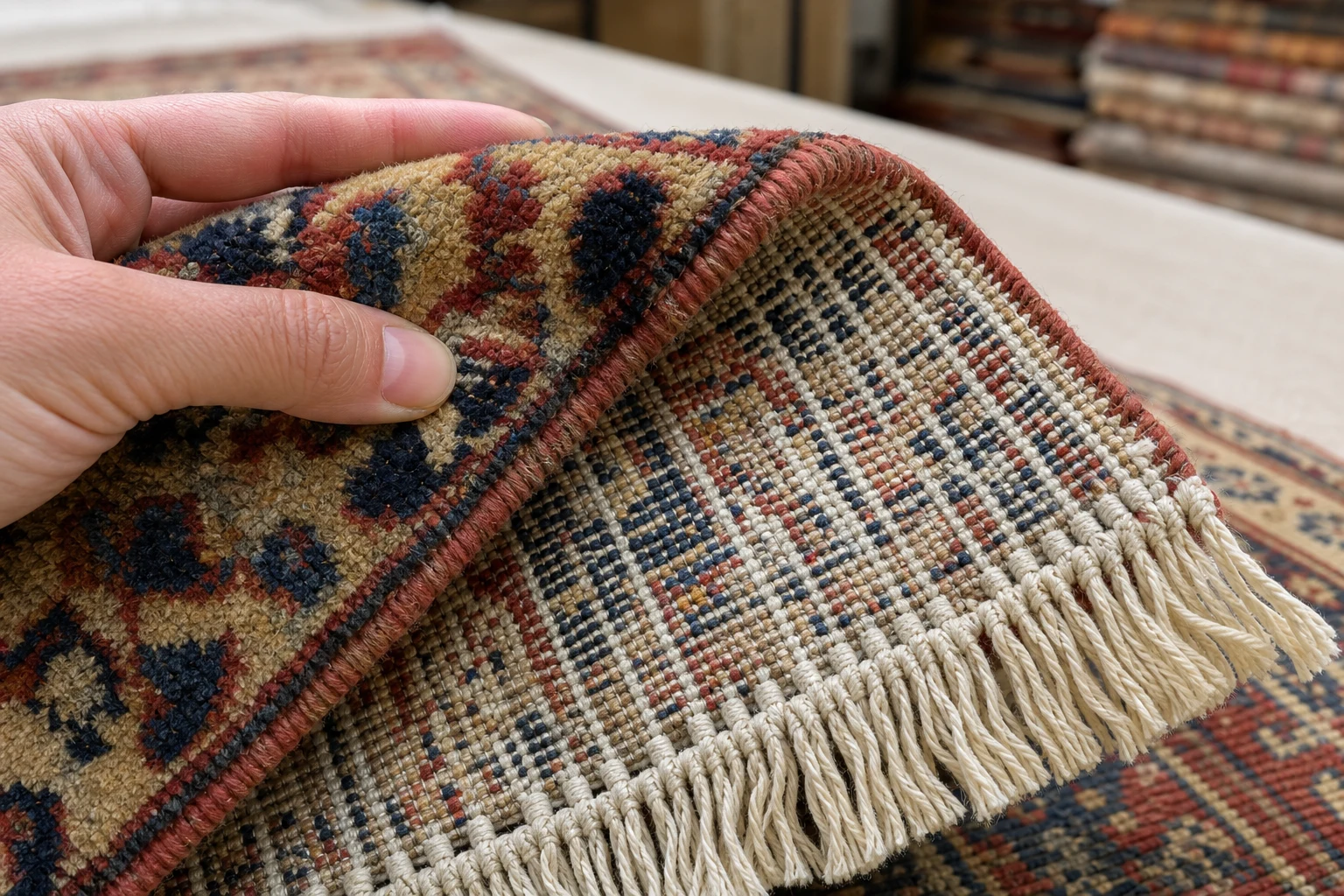
One corner can reveal four important things at once: pile on the face, knot structure on the reverse, the side binding and fringe that relates to the warp.
A machine-made rug can be very convincing
Modern machine production can imitate traditional designs very well. The difference is not whether you like the rug, but how it was made. A machine-made rug does not contain individually hand-tied knots; its back is often very regular and its structure follows the technology used.
Some machine-made rugs include decorative fringe, a persuasive aged look or a reverse designed to resemble handwork. Do not look only for irregularity or fringe. Ask whether real knots are visible and whether the fringe belongs to the warp.
Regularity alone does not decide it
People often say that a genuine hand-knotted rug must be irregular. That is only partly true. A fine workshop rug can be very regular, while an inexpensive machine-made rug may deliberately imitate small variations.
Look for hand knotting in structure, not in a romantic idea of imperfection. Modest shifts in width, drawing or colour may belong to manual work, but severe buckling, a brittle foundation, distortion or hidden repair are practical problems.
Knot density is not a certificate of authenticity
Knot count helps describe fineness and the ability to render detail. It does not by itself prove that a rug is genuine, high quality or suitable for your room. A coarser hand-knotted village rug may be honest and durable, while a fine-looking imitation may be mainly marketing.
If a seller states density, check the unit: knots per square centimetre, square decimetre or square inch. Also ask whether they are counting true knots, not colour points or both halves of one knot.
Material and touch can help, but not alone
Wool should feel resilient and textile, while silk has a distinctive sheen and changes with pile direction. Synthetic material may feel very smooth, cooler or plastically shiny, but touch is not proof. There are strong and weak wools, different finishes and blended fibres.
Judge material together with construction. Silk pile on a cotton foundation, wool on wool warps or cotton foundation in an urban carpet can all be legitimate. The problem is when the seller cannot describe the material clearly or uses “silk” for any shiny effect.
A certificate helps only when it is specific
A certificate can be useful if it includes a photograph of the exact rug, dimensions, materials, construction, origin, condition and the issuer's details. A generic paper containing the word “authentic” without concrete data is not independent proof.
For an ordinary new rug, a precise invoice and clear description may be enough. For an older or more expensive piece, a fuller report or independent assessment makes sense. If value depends on age, area or rarity, those claims need stronger support than a verbal assurance.
A quick inspection table
| What to inspect | In a hand-knotted rug | Warning sign |
|---|---|---|
| Reverse | Visible knots, wefts and design without adhesive backing | Full backing cloth, latex or hidden construction |
| Fringe | Often continues from the warp threads | Sewn-on decoration presented as original warp |
| Sides | Structural edge from outer warps and binding | Plastic or glued edge unrelated to the textile |
| Reverse design | Technically legible and related to the face | Printed, perfectly flat image or covered reverse |
| Seller description | Technique, material, origin, condition and terms | Only broad words like “handmade”, “genuine”, “luxury” |
Step-by-step inspection
- Open the whole rug and view it from both pile directions.
- Fold a corner on a clean surface and inspect the reverse.
- Check whether fringe continues from the warp or is sewn on later.
- Examine sides, ends, repairs, stains and distortion.
- Ask for the exact technique and pile and foundation materials.
- Request a written description and return terms.
- For an expensive rug, consider independent assessment before purchase.
A genuine hand-knotted rug is best recognised as a complete construction: the reverse shows how it is made, fringe and sides show their relationship to the warp, material and condition reveal practical value, and a good seller helps separate facts from probable attributions.