
Advice and inspiration
How long does it take to make a hand-knotted rug?

The short answer is anywhere from several weeks to several years. A typical hand-knotted rug for an interior is usually measured in months of production rather than days. Its size alone cannot provide an exact completion date. Two rugs measuring 200 × 300 cm can require very different amounts of work when one has an open geometric pattern and the other an exceptionally fine floral design.
Knotting usually consumes the largest share of the schedule. Every knot is formed by hand around the warp threads; after a row is completed, weft is inserted, the row is beaten down with a comb and the pile is progressively clipped. Before weaving begins, the design, materials and loom must be prepared. Washing, drying, stretching and final finishing follow after the rug leaves the loom.
The number of knots matters more than the number of days
Total knot count is the clearest way to understand the pace of production. It combines the area of the rug with its knot density. A 6 m² rug at 160,000 knots per m² contains about 960,000 knots. At 400,000 knots per m², the same dimensions represent about 2.4 million knots.
This is an illustration, not a universal measure of quality. A robust village rug can be excellent at a lower density, while a fine city design needs more knots to render small flowers, curves and outlines.
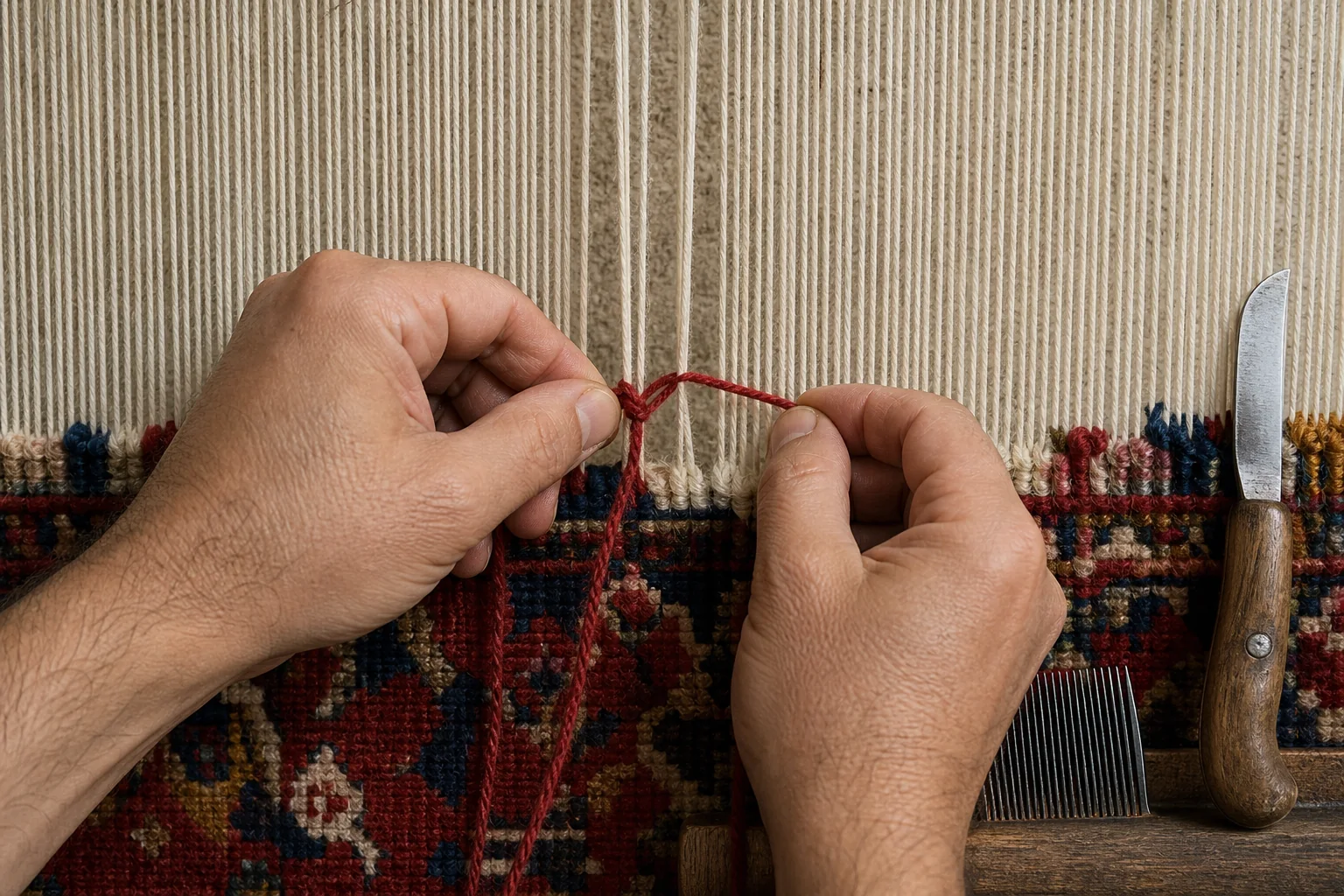
Every row of the design combines individual knots, inserted weft, beating with a comb and progressive clipping of the pile.
What has the greatest effect on production time
- Dimensions: a larger area normally means more rows and knots. The width also determines how many weavers can work comfortably at the loom.
- Knot density: a finer foundation and more knots allow more detailed drawing, but each centimetre advances more slowly.
- Design complexity: broad areas of one colour can proceed more fluently than tiny flowers, figures or frequent colour changes.
- Materials: fine wool, silk highlights and an all-silk structure require different tension, precision and clipping.
- Number and experience of weavers: several people may share a wide loom, but they must maintain consistent tension and accuracy. Twice as many weavers therefore does not automatically halve the schedule.
- Working rhythm: holidays, seasonal work, yarn availability, drying dyed material and correcting errors all affect calendar time.
- Finishing: washing, drying, stretching, correcting the shape, securing the sides and final clipping may add days or weeks.
Indicative times for different rugs
| Type of commission | Typical work involved | Very broad estimate |
|---|---|---|
| Small rug up to about 1 m² | Simple to moderately fine design, one weaver | Several weeks to several months |
| Room-size rug around 200 × 300 cm | Medium fineness, one or several weavers | About 4 to 12 months |
| Fine detailed rug of a similar size | High density, many colours and curves | Roughly 8 to 18 months, sometimes longer |
| Exceptionally large or very fine piece | Large team, demanding design and extensive finishing | One to several years |
These ranges are only a guide. Traditions, workshops, knotting techniques and working arrangements differ considerably. Monumental historic carpets could occupy a team of expert weavers for several years, while a small rug with an open pattern can be completed much sooner.
Production does not begin with the first knot
- Design and calculation: dimensions, colours, density, materials and motif placement are established. A city workshop may use a detailed cartoon, while some village and nomadic traditions work from memory.
- Yarn preparation: wool is sorted, spun, washed and dyed. Dyed yarn must dry evenly before its shades are organised at the loom.
- Warping the loom: the foundation requires the correct number of threads at consistent tension. An error here can affect the shape of the entire rug.
- Knotting and inserting weft: knots are formed row by row, weft passes between them and the structure is compacted with a comb. This is normally the longest stage.
- Finishing: after the rug is cut from the loom, its ends and sides are secured, then it is washed, dried, stretched and clipped to an even pile.
Time on the loom is not the same as lead time
The delivery period for a made-to-order rug may be longer than the knotting itself. It can include approval of artwork and samples, a place in the workshop schedule, colour preparation, quality control, transport and customs formalities. Conversely, a completed rug in stock can be taken home immediately even though making it took many months.
A responsible estimate therefore gives a range and explains what the period includes. An exact date promised before dimensions, density, materials and workshop capacity are confirmed should be treated cautiously.
Longer production does not automatically mean better quality
Time mainly reflects the quantity and difficulty of the work. Quality must still be judged from the materials, firmness of construction, clarity of drawing, colours, shape and edge finishing. A slowly produced rug is not necessarily good, and a simpler rug completed sooner is not necessarily inferior.
Nor can a long claimed production period prove that a rug is handmade. The decisive evidence is its actual construction, visible on the reverse: individual knots, warp, weft and fringes that continue from the foundation.
What to ask when commissioning a rug
- What are the exact dimensions, materials and approximate knot density?
- How many weavers will work on it and in what kind of workshop?
- Does the stated period cover knotting only, or design, finishing and delivery as well?
- How are natural handmade variations handled, and who checks dimensions, colours and shape?
- At what stages will you receive progress confirmation or photographs from the loom?
A hand-knotted rug is a slow-made object because its surface does not appear all at once: it grows knot by knot and row by row. This labour-intensive structure is also what makes skilled repair possible, supports a long service life and creates drawing that is fundamentally different from a printed surface.