
Advice and inspiration
How to tell a genuine Persian rug from an imitation

To identify a genuine hand-knotted Persian rug, you need to verify two separate facts: where it was made and how it was made. “Persian” describes origin in Iran. “Hand-knotted” describes a construction in which individual pile knots are tied by hand around the warp.
A Persian-design rug made in Pakistan, India or Turkey may be honestly hand-knotted and excellent, but its country of origin is not Iran. Conversely, a machine-made rug produced in Iran has Iranian origin but is not a traditional hand-knotted Persian rug. The appearance of the motif proves neither point.
First decide what you are trying to verify
| Question | What can confirm it | What is not enough on its own |
|---|---|---|
| Is the rug Persian? | Documented origin in Iran and features consistent with the stated region | A Persian motif, a name such as Tabriz or Kashan, or a marketing slogan |
| Is it hand-knotted? | Visible individual knots, an uncovered reverse and pile tied around the warp | The word “handmade”, which may also include tufting |
| Is it good quality? | Materials, structural integrity, workmanship, condition and suitability for use | Knot count or a high price alone |
| Is it old or collectible? | Expert assessment of structure, age, condition and documented provenance | A faded appearance, manufactured patina or the vague word “antique” |
1. Lift a corner and examine the reverse
The reverse is the quickest place to begin. On a hand-knotted pile rug, the drawing is legible from the back and close inspection reveals rows of individual knots with the warp and weft passing through the structure. The reverse is not normally concealed by a rigid textile layer or a continuous coating of latex.
Hand-knotting does not have to look conspicuously irregular. A fine city rug from a skilled workshop can have remarkably precise drawing and very even knots. Machine-made imitations can also simulate variation. Do not hunt for a “mistake”; look for the actual structure.

Individual knots and the design can be followed on a hand-knotted reverse; machine construction is usually mechanically uniform and its fringe may be attached separately.
2. Distinguish hand-knotted, hand-tufted and machine-made
“Handmade” is not the same as “hand-knotted”. In a hand-tufted rug, yarn is inserted with a tufting gun into a prepared foundation cloth. The pile is then secured with adhesive and the back is often covered by another textile layer. It is faster to produce and structurally different from a rug in which each knot is tied around the warp.
A machine-woven rug usually has an extremely regular structure, machine-finished edges and a repeating weave. Fringes may be sewn on after production. Modern machines can produce a convincing Persian pattern, however, so the face photograph matters less than the reverse and an accurate description of the technique.
3. Fringes are a clue, not a verdict
On many hand-knotted rugs, the fringes are the exposed ends of the warp threads on which the rug was built. At close range, they therefore continue naturally from the foundation. On machine-made and some tufted rugs, decorative fringe may be stitched to the completed edge, with a seam visible from the reverse.
There are exceptions. Fringes may be shortened, secured or professionally replaced during the rug's life. Scholarly descriptions also record traditional end finishes in which warp ends are braided or otherwise worked, and occasionally added fringe. Judge the fringe together with the reverse, edges and documentation rather than in isolation.
4. Materials inform the assessment but do not prove origin
Traditional Persian rugs often have a wool pile on a cotton or wool foundation. Fine city pieces may combine wool and silk or be made entirely from silk. Ask separately about the pile, warp and weft; these components need not use the same fibre.
A natural material does not prove Persian origin or hand-knotting. Wool rugs are made in many countries, and a good machine-made rug can also use wool. High lustre does not automatically mean silk either: it may be viscose or another regenerated cellulose fibre. Have the exact composition recorded in writing.
5. Colour and small irregularities are not proof
Gentle horizontal changes of tone known as abrash can result from hand-dyed yarn produced in separate dye batches. They may be a natural and appreciated feature of a traditional rug. Similar effects can now be created intentionally, so abrash alone does not establish authenticity.
Synthetic dyes do not automatically mean an imitation either. They have a long history in Persian production; the quality of dyeing and its relationship to the rug's stated age matter more. Do not test colourfastness at home with a damp cloth, chemicals or vigorous rubbing, even in a concealed area. An improvised test can cause bleeding or permanent surface change.
6. A “Persian knot” is not a geographical certificate
Persian rugs use both asymmetrical and symmetrical knots. The older trade names “Persian” and “Turkish” knot are misleading because both structures occur across different parts of the Near and Middle East. Knot form alone cannot confirm a country of origin.
Knot density is a useful technical specification: a higher density allows finer drawing, but it is not a universal test of authenticity or quality. A robust village rug may have fewer knots and still be genuine, strong and valuable. Materials, weave, workmanship and rug type must be considered together.
7. Verify the origin and identity of the individual rug
A document or certificate is useful only if it clearly describes the rug in front of you. It should correspond to its photograph or stock number, exact measurements, country and region of origin, materials, technique, approximate age and known condition. A decorative sheet with a stamp but no identifying information is not a substitute for informed assessment.
Compare the information with the object: measure the rug, inspect its materials and structure and ask about restoration on an older piece. A reputable seller distinguishes documented information from expert attribution, permits inspection of the reverse and records the essential details on the sales document.
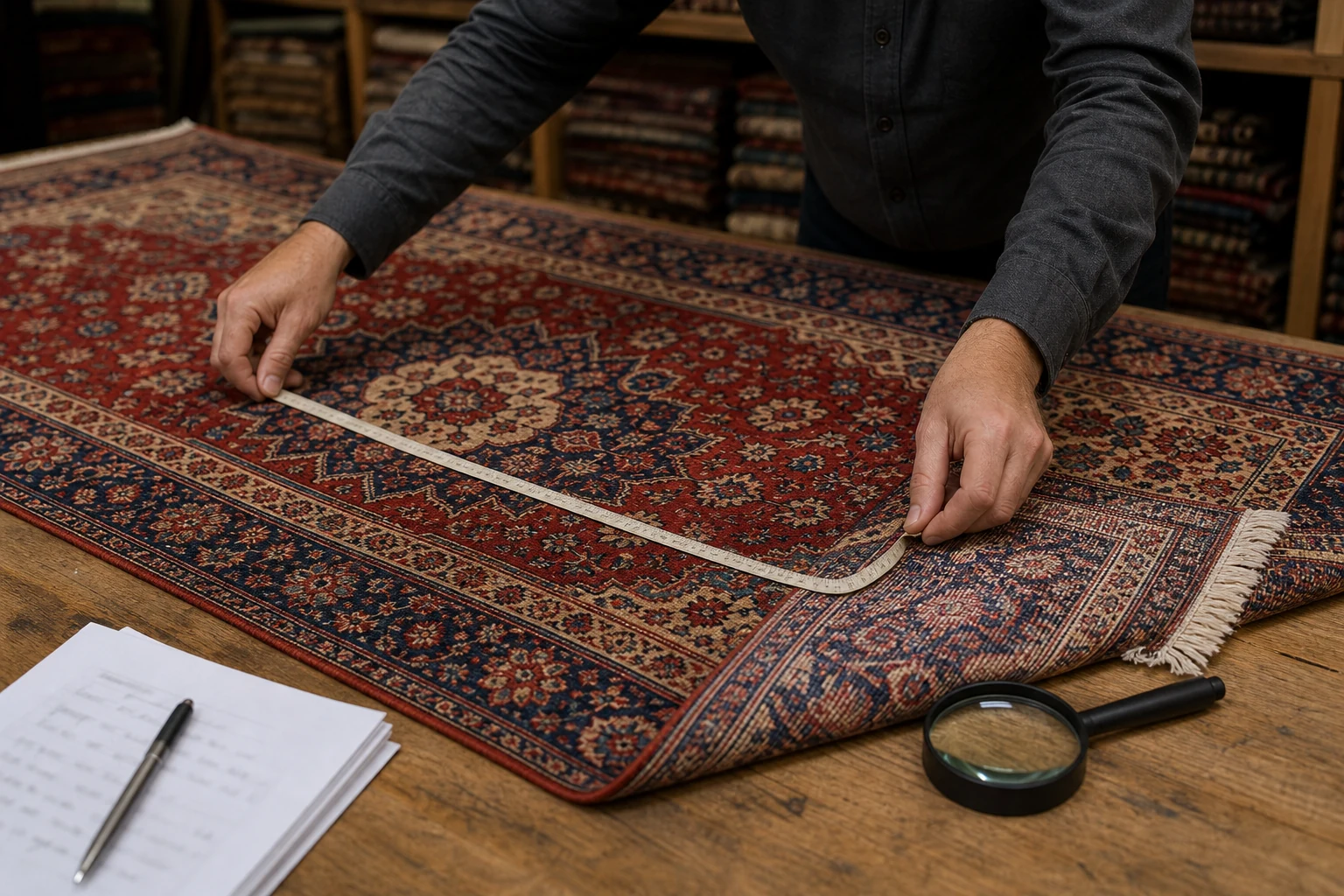
Documentation should identify one specific rug and agree with what can be verified physically.
8. Condition helps reveal the rug's real history
On an older rug, inspect the pile, sides, ends and reverse. Look for exposed foundation, loose threads, insect holes, abrupt changes in pile height, stains, musty odour, stiff areas from adhesive and mismatched repairs. Consider whether the natural wear is consistent with the claimed age.
A repair does not make a rug fake. A good older piece may have been professionally conserved. The extent of the work should nevertheless be disclosed and reflected in the price. A newly made rug with an aged finish is also a legitimate product when it is transparently described as new and deliberately finished.
A five-minute check before buying
- Read the country of origin and do not let a design name replace it.
- Ask for the exact technique: hand-knotted, tufted, flat-woven or machine-made.
- Lift a corner and compare the visible drawing, individual knots and any backing layer.
- Examine how the fringe meets the foundation, without treating it as the only proof.
- Confirm the materials in the pile, warp and weft.
- Measure the dimensions and compare them with the documentation.
- Inspect the entire condition from both sides and request disclosure of known repairs.
Warning signs
- the seller will not show the reverse or open the rug out fully,
- “handmade” is used without explaining the exact technique,
- a Persian motif is presented as proof that the rug was made in Iran,
- every irregularity is described as a guarantee of handwork,
- natural silk cannot be distinguished from viscose,
- the certificate contains no details that identify the individual rug,
- you are pressured to buy before you can carry out a calm inspection.
Home tests to avoid
Do not burn fibres, apply chemicals, soak the rug or pull yarn forcefully from the pile. Do not make a sharp fold or attempt to dissolve adhesive on the back. These methods can damage a rug and still fail to provide a reliable answer without specialist experience. If doubt remains, arrange an in-person examination.