
Advice and inspiration
Modern vs. traditional designs in hand-knotted rugs

The difference between a modern and a traditional hand-knotted rug lies primarily in its visual language, not automatically in its quality. Either may be tied knot by knot, use excellent wool or silk and take many months to make. A traditional rug works with compositions and motifs developed across generations; a modern piece may use the same technique for abstraction, large-scale geometry, asymmetry or an almost monochrome field.
The useful question is therefore not simply “what belongs in a modern home?” but: should the rug calm the room, connect it, or become its principal image? A traditional pattern can look unexpectedly contemporary against simple furniture, while a modern rug can lighten a historic room. Proportion, colour, pattern scale and the relationship with furniture matter more than the style label.
What a traditional design usually means
Traditional Persian and Oriental rugs do not form one uniform group. They vary by region, workshop, period and production context. Several broad compositional principles nevertheless recur:
- Central medallion: a main element organises the field around the centre, often with related corner pieces and a pronounced border.
- All-over repeat: flowers, vines, rosettes or geometric units continue across the field without one dominant centre.
- Garden or compartment design: the field is divided into ordered sections containing plants, trees, water elements or small scenes.
- Directional design: the drawing has a clear top and bottom, as in rugs with a niche or tree composition.
- Geometric composition: diamonds, hooked forms, polygons and stylised animals can be just as traditional as finely drawn flowers.
The border is not merely extra decoration. It closes the field visually, holds the composition together and helps define the relationship between the rug and the surrounding floor. On some rugs, the main border is accompanied by several narrower guard stripes, each with its own rhythm.
Medallions, arabesques, boteh and other motifs
Familiar elements include medallions, palmettes, floral vines and arabesques, rosettes, leaves, lattices, diamonds and the drop-shaped boteh. A motif cannot, however, be translated into one universal sentence without context. Its meaning and use may vary with region, period and the rest of the composition.
Traditional does not mean mechanically copied. Designer and weaver work with the balance between field and border, density of drawing, rhythm of repetition and hierarchy of colour. A fine city rug may render elegant curves and tiny flowers, while a village or nomadic piece may be deliberately more direct, geometric and spontaneous.
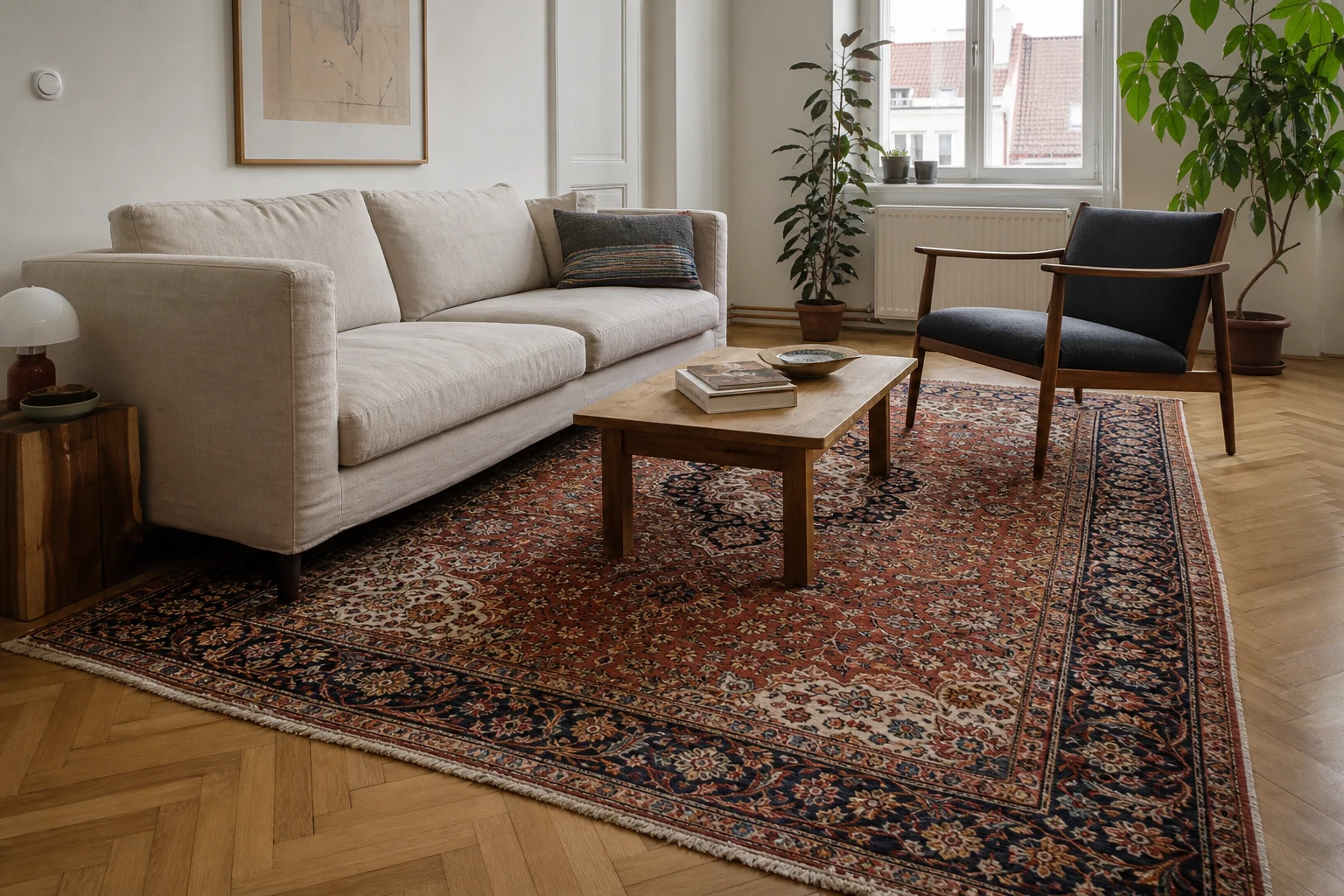
A traditional drawing does not require a period interior. In a quiet room it contributes detail, colour and depth that simple furniture allows us to see clearly.
What makes a hand-knotted rug look modern
A modern design may leave traditional ornament behind entirely or simply reduce it. It often uses broad fields, irregular geometry, blurred transitions, asymmetry, deliberate negative space or a tightly limited colour family. The composition may recall painting, graphic art, stone, landscape or a hand-drawn mark without literally depicting an object.
This appearance tells you nothing certain about construction. A modern rug may be hand-knotted, hand flat-woven, hand-tufted or machine-made. If technique matters to you, ask specifically how it was made, what the pile, warp and weft contain, and inspect the reverse. “Designer rug” is not a technical specification.
Texture often plays a larger role in contemporary hand-knotted rugs. Variation in pile height, a combination of matte wool and a more reflective fibre, or a change in pile direction can create a drawing without strong colour contrast. Relief should still suit the room: an even surface is often more practical under dining chairs or in a busy route.
Transitional design bridges the two
Many rugs do not belong honestly in only one category. A transitional design may enlarge a traditional palmette, dissolve part of a medallion, remove the classical border or translate a historic ornament into sand, grey and rust. In another piece, the traditional structure remains recognisable but sections of the drawing appear intentionally interrupted or worn away.
This group is useful when you want the depth and crafted character of a traditional rug but a fully symmetrical ornament feels too formal. Be careful with artificial “patina”, however: an aged effect is a design treatment, not evidence of genuine age.
A quick comparison
| Feature | Traditional design | Modern design |
|---|---|---|
| Composition | Medallion, all-over rhythm, compartments, defined border | Abstraction, asymmetry, large geometry, open field |
| Pattern scale | Often many smaller connected details | Often a few broad forms or restrained texture |
| Colour | Several layers and tones in an interrelated palette | From monochrome to strongly contrasted |
| Furniture relationship | Medallion and border need considered coverage | Large gestures must be judged in the visible crop |
| Typical effect | Depth, rhythm and a historical or crafted layer | Calm, a graphic accent or contemporary tension |
| Technique | Either style may be hand-knotted; appearance alone does not confirm construction | |
First decide the rug's role in the room
If the room already contains emphatic artwork, a colourful bookcase, strongly veined stone or patterned upholstery, a quiet modern rug with subtle texture may provide useful calm. If the interior is based on a neutral sofa, timber and plain walls, a traditional rug can supply the missing scale, colour and visual memory.
You do not need to match a rug to the age of the building. Contrast can be more convincing than literal stylistic repetition: a Persian medallion has room to breathe in a minimalist living room, while an abstract rug among plaster mouldings and aged wood prevents the interior from feeling like a period set.
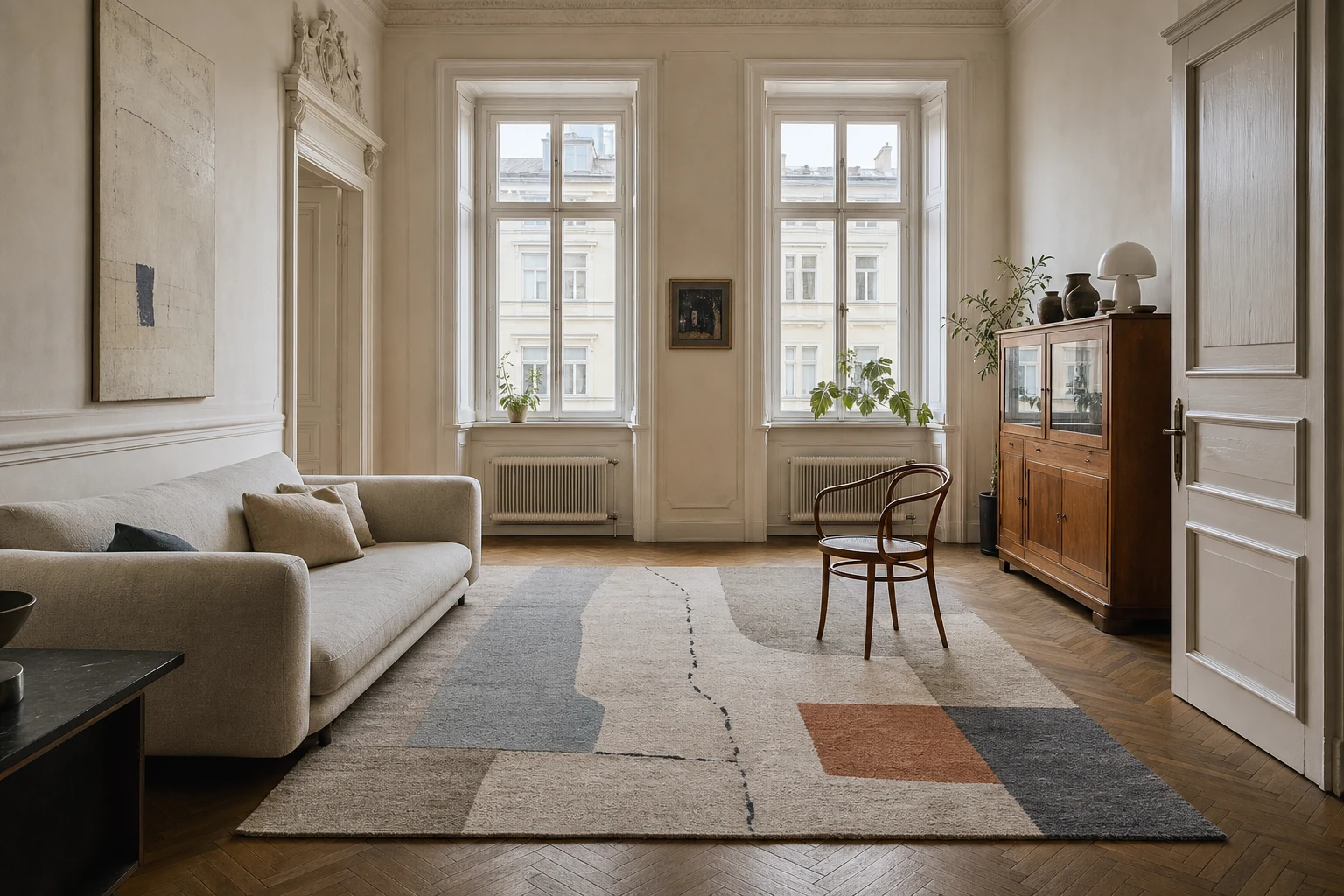
A contemporary rug can calm and clarify classical architecture. Its dimensions and colour temperature still need to respond to the actual materials in the room.
Pattern scale matters as much as style
A large medallion is easiest to appreciate when furniture does not conceal its essential part. Partial coverage beneath a coffee table can work, but check what remains visible from the seats used every day. An all-over repeat is more forgiving because the drawing continues beneath furniture.
On a modern rug, one coloured field may occupy half its width. It looks balanced in a small product image, yet the room may reveal only a crop of it. View the whole rug from several metres away as well as close up. In a small room, a medium-scale drawing can work better than one enormous gesture or an extremely dense small pattern.
Choose colour in the room, not by its name
“Beige”, “blue” or “red” is not precise enough. Undertone, quantity and neighbouring materials determine the result. Brick red behaves differently beside oak from a cool crimson beside grey stone. You do not have to repeat every colour in a complex traditional rug; drawing two or three quieter tones into a cushion, artwork or ceramic object is often enough.
Pile reflects light differently according to viewing direction. The same rug can therefore look darker and richer from one end and lighter after it is turned. Assess colours in daylight and evening light and view the rug from the places where you will most often see it.
Furniture should not break the composition by accident
- Living room: the rug should connect the seating group. At least the front legs of the main pieces should stand securely on it.
- Dining room: the pattern must continue to work beneath the table, and the rug should extend far enough for chairs to remain on it when pulled out.
- Bedroom: consider the areas visible at the sides and foot of the bed; a central medallion may disappear completely beneath a wide bed.
- Hallway: a directional motif reinforces the axis, while an all-over drawing usually tolerates changing viewpoints and traffic more easily.
Before visiting the showroom, mark the proposed dimensions on the floor with paper tape. Photograph the room in daylight from several corners and bring a sample of any fabric or material that genuinely matters. A phone image may shift colour, but it helps assess proportion and the amount of pattern already present.
How to compare rugs in a showroom
- Have both rugs opened out fully rather than viewing only an edge in a rolled stack.
- Look at them close up, from several metres away and from both pile directions.
- Place a sample or object approximating the colour of your floor or sofa beside them.
- Cover the future table position with a sample and see whether the composition still holds together.
- Compare exact dimensions, fibre, pile height and suitability for traffic, not only photographic style.
- Photograph the complete rug in neutral light and request precise information about origin and technique.
Common selection mistakes
- assuming that a modern interior can contain only a modern rug,
- trying to match the sofa and rug colour exactly,
- judging a traditional rug only by the symbolic “meaning” assigned to one motif,
- choosing from a detail photograph without seeing the full composition,
- buying too small a size and leaving furniture floating around it,
- allowing furniture to obscure the medallion or the decisive contrast in a modern drawing,
- letting “modern” or “traditional” replace checks of material, construction and condition.