
Advice and inspiration
What are the most common designs on Persian rugs?

There is no single universal Persian rug pattern. The name covers many urban, village and nomadic weaving traditions, each with its own layouts, motifs, colours and rhythm. One rug may be organised around a large central medallion, another may repeat an ornament across the whole field, while a third may use geometric forms or a compartmented garden design.
It helps to separate two ideas when reading a rug. The layout describes how the entire surface is organised – central medallion, all-over repeat or prayer niche, for example. A motif is a smaller element within that layout, such as a boteh, palmette, rosette, leaf, bird or diamond. Trade terminology is not always consistent, and the same motif can occur in several regions and periods.
The most common layouts at a glance
| Design family | Visual clue | Where it works well |
|---|---|---|
| Central medallion | One dominant centre, often supported by matching corner pieces | A living room or open area where the rug should create a focal point |
| All-over repeat | A motif repeats across the field with no single dominant centre | Under a dining table or furniture that would partly cover a medallion |
| Geometric layout | Diamonds, stars, hooks and stylised plants or animals | A relaxed, graphic or restrained interior |
| Garden or compartment design | The field is divided into panels containing flowers, trees and water imagery | A larger visible area where the separate compartments can be appreciated |
| Prayer niche | A directional layout with an arch resembling a mihrab | A quiet room or display where the design’s orientation can be respected |
| Pictorial rug | Figures, animals, landscape, architecture or a literary scene | A statement position, wall display or lower-traffic area |
Central medallion: making the rug the focal point
The medallion layout is one of the most recognisable forms of Persian rug design. A large circular, oval, star-shaped or lobed motif sits in the centre of the field and may include pendants above and below. The corners often contain quarters of a related motif, visually linking the centre to the border.
This type of rug feels formal and focused. It works especially well where the centre remains visible, such as between sofas or in the open part of a living room. Fine curves, flowers and arabesques are often associated with urban workshop rugs, while some Heriz designs interpret a medallion in a much more angular way. Shape alone, however, is not enough to identify a specific weaving centre with confidence.
All-over patterns: rhythm without a dominant centre
In an all-over composition, the design continues from edge to edge. The rug therefore keeps its visual logic even when a table, bed or sofa covers part of it. Depending on the scale and contrast of the repeat, the result can be quiet and finely textured or exceptionally rich.
A well-known example is Herati: a rosette is commonly enclosed by a diamond and surrounded by curved leaves that are sometimes interpreted as fish. Networks of stems, palmettes, rosettes and blossoms also appear in patterns known as Mina Khani or Shah Abbasi. You do not need to memorise every name. More useful is to notice the scale, density and continuity of the repeat and how it interacts with the field colour.
Geometric, village and nomadic designs
A geometric rug relies on straighter lines, diamonds, octagons, stars, hooked forms and strongly stylised plants or animals. The drawing may feel more spontaneous and rhythmic than that of a finely drafted urban rug. Small deviations, colour shifts and irregular repeats can be natural evidence of hand work rather than automatic defects.
Terms such as “tribal”, “village” or the name of a particular area should not be assigned from angular drawing alone. Motifs travelled between workshops, families and trading centres, and historic layouts are now woven far beyond the places with which buyers usually associate them.
Gardens, trees, boteh and other motifs
Garden or compartment designs divide the field into rectangles or squares. Individual panels may contain trees, flowers, shrubs, birds and sometimes suggestions of water channels. A familiar version is the so-called garden or brick pattern associated with Bakhtiari rugs. The result can be read almost like a map of an idealised garden.
The boteh resembles a curved leaf, droplet or cypress and is related to the form known in the West as paisley. The tree of life, cypress, flower-filled vases, birds and animals can form the main subject or appear as small filler motifs. It is tempting to give every symbol one fixed meaning, but interpretation can vary by place, period and weaving tradition.
The border is more than a frame
Most Persian rugs are surrounded by one main border and several narrower guard borders. The main band may carry flowering vines, palmettes, rosettes or a geometric alternation, while the smaller bands close the composition rhythmically. A strong design connects border and field without allowing either to overwhelm the other.
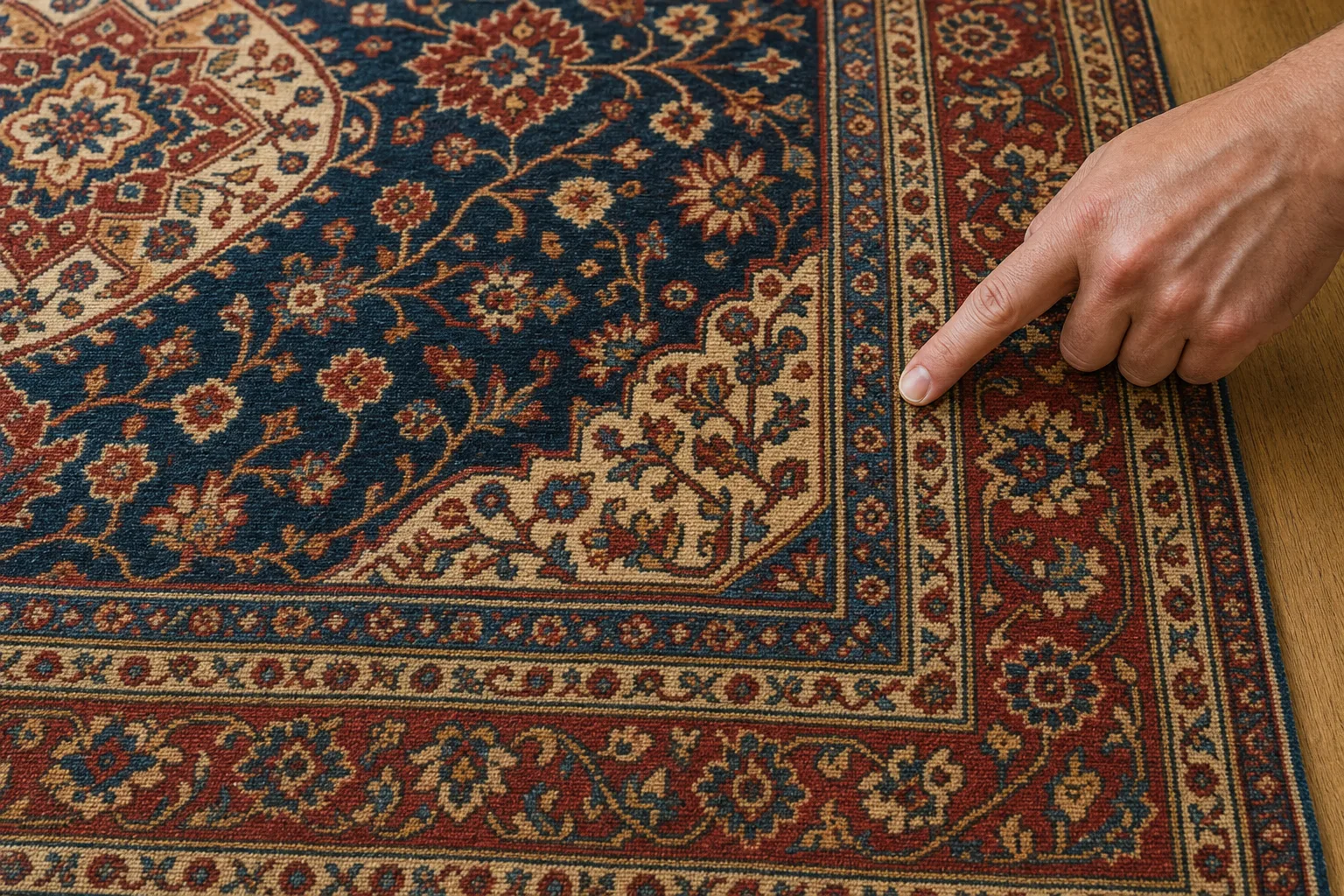
The field, corner pieces, main border and narrow guard borders work as one composition. When choosing a rug, look beyond the centre and examine the drawing and condition of its edges too.
Borders are also a practical place to examine condition. Check whether the side edges are rippled, rebuilt or heavily worn, whether the design turns naturally at the corners and whether part of the original end is missing. A perfectly resolved motif in every corner is not a universal test of quality; what matters is whether the whole design is consistent with the construction, age and character of the individual rug.
How to choose a design for your interior
- In a smaller room, a finer repeat and softer contrast are often easier to live with because they do not visually divide the space.
- In a large living room, a strong medallion or generous geometric layout can establish a clear focal point.
- Under a dining table, an all-over pattern is practical because covering the centre does not disrupt the composition.
- In a minimalist interior, one confident rug can act like the main artwork and bring warmth to the room.
- In a richly furnished room, choose by scale, contrast and tone rather than simply counting how many ornaments are present.
Photography is a useful starting point, but view the rug in person if possible. Pile direction changes the apparent lightness of colours, fine drawing blends together from a distance, and a large motif may feel calmer in a real room than it does in a close photograph.
What pattern alone cannot prove
A pattern by itself does not prove that a rug was made in Iran, that it is old, hand-knotted or high quality. Historic compositions are copied in many countries and trade labels are sometimes used loosely. Always assess the face together with the reverse, knot structure, materials, fringe, colour, condition and any reliable provenance.