
Advice and inspiration
The most common materials in hand-knotted rugs: what are you really buying?

The most common construction is wool pile on a cotton warp and weft. It is not the only valid choice. Fine rugs may add genuine silk, traditional village pieces can be made entirely of wool, and contemporary production also uses regenerated cellulose fibres. The important question is therefore not merely the name of the material, but where in the rug it is used and whether it suits the intended traffic.
Fibre affects resilience, lustre, precision of drawing, response to moisture and the correct cleaning method. It does not determine quality on its own. Good wool can serve for decades, while an expensive fibre that has been poorly prepared cannot rescue a weak structure.
One rug, three material questions
A label may say only “wool” or “wool and silk”. An accurate description distinguishes three structural layers:
- Pile: the short ends of coloured knots on the face. They create the visible surface, design and handle and are most often wool, silk or a combination.
- Warp: the lengthwise load-bearing threads tensioned on the loom. Knots are tied around them and their ends normally continue as the fringe.
- Weft: crosswise threads passed between rows of knots. They secure the structure and influence how firmly the rows are seated.
A rug can therefore be accurately described as wool while having cotton fringe: its visible pile is wool, while the fringe continues from a cotton warp. Ask for the pile and foundation fibres to be specified separately when you buy.
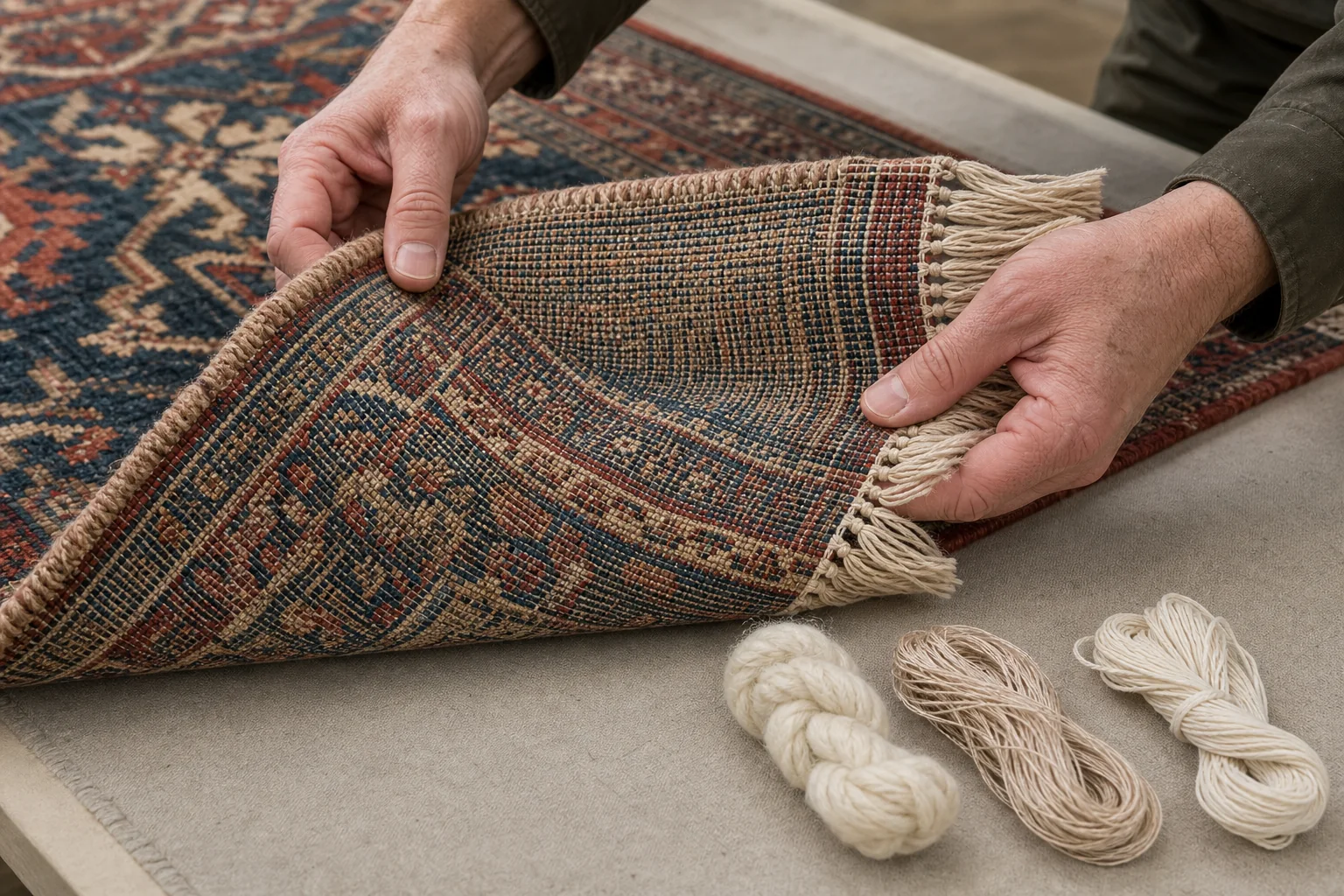
The reverse and fringe reveal the foundation; sheen on the face alone cannot identify a fibre reliably.
Sheep's wool: the practical choice for most rooms
Sheep's wool is the most common pile fibre for good reason. Its natural crimp gives yarn resilience, it accepts dyes well and a sound pile gradually recovers after compression. Wool also scatters light more softly than smooth silk, giving a design a warm, dimensional appearance.
The word “wool” does not describe grade. Fibre length and strength, the quantity of loose short fibres, cleanliness, spinning and an appropriate pile height all make a difference. Well-prepared wool pile should not feel brittle or artificially slippery, and the structure should remain firm when a corner is flexed gently.
For a living room, bedroom or sensibly maintained hallway, good wool is usually the most versatile option. In a heavily used area, material should be considered together with a relatively low pile, firm construction, sound edges and an appropriate underlay.
Genuine silk: detail and light, not an automatic quality grade
Silk is a very fine continuous filament. It supports minute contours, and its smooth surface reflects light strongly enough for colour and tone to change when the rug is viewed from opposite directions. It may form the complete pile, luminous details in a wool design, or a particularly fine warp and weft.
Silk's higher price does not make every silk rug the best choice for every room. It is less elastic than wool and sensitive to prolonged light exposure. A very fine piece therefore makes more sense in a quiet formal area than beneath a castor chair, dining table or the household's main route.
The description “wool with silk” also needs clarification. It can mean a few discreet highlights or a substantial proportion of the pile. Ask for the percentages and whether the silk is in the pile or only in the structural foundation.
Cotton: often invisible, structurally important
Cotton is commonly used for the warp and weft of city and workshop rugs. It can be tensioned consistently, providing a stable foundation for accurate drawing and a regular format. It may be entirely invisible on the face but becomes clear on the reverse and at the fringe.
The fringe of a hand-knotted rug is normally not decoration sewn to the finished object. It consists of the free warp ends upon which the rug was built. A later sewn-on fringe tape therefore says nothing about the original warp fibre and may conceal a repair or altered finish.
A cotton foundation is not a grade of cheapness or luxury. It appears in ordinary wool rugs and exceptionally fine workshop pieces alike; it must be judged together with the weave, pile fibre and quality of execution.
All-wool structures and other animal fibres
Some village, tribal and nomadic traditions use wool for pile, warp and weft. Such a rug is usually more supple and may have a less geometrically regular outline than one made on a tightly tensioned cotton warp. Small variations can belong to its method of manufacture; severe rippling, loose sides or a brittle foundation are condition concerns, not “proof of handwork”.
Goat hair or camel fibre occurs less frequently in structural parts or selected areas. Colour alone is not enough to identify it: several fibres can be naturally brown, and the yarn may also have been dyed. Specialist assessment is safer for an unusual or valuable rug.
Viscose, rayon and “bamboo silk”
A bright surface is not necessarily genuine silk. Contemporary rugs may use viscose, rayon, lyocell or another regenerated cellulose fibre. Trade phrases such as “art silk” and “bamboo silk” sound luxurious, but do not by themselves mean animal silk produced by a silkworm. Soft textiles made from chemically processed bamboo cellulose are typically rayon or viscose made from bamboo, not natural bamboo fibre and certainly not silk.
There is no need to reject such a material automatically. It does, however, have different performance characteristics and may respond differently to water, abrasion and cleaning products. Accurate description is what matters. If a seller uses only a poetic name, ask for the generic fibre name and percentage to be recorded in writing.
The common fibres at a glance
| Material | Where it is commonly used | Main character | What to consider |
|---|---|---|---|
| Sheep's wool | Pile, sometimes warp and weft | Resilient, warm surface that takes dye well | Yarn grade, pile height and firmness of construction |
| Genuine silk | Pile, details or a very fine foundation | Precise drawing and changing lustre | Light, mechanical wear and specialist cleaning |
| Cotton | Most often warp and weft | Consistent, stable structural foundation | It may be invisible on the face; inspect reverse and fringe |
| Regenerated cellulose | Lustrous pile or highlights in modern rugs | Smooth, bright surface | Ask for the exact fibre name and care advice |
Which material suits the way you live?
- Everyday living room: good wool pile on a sound foundation generally offers the best balance of comfort and resilience.
- Hall or busy zone: look for firm wool construction, a lower pile, healthy edges and stable underlay; keep fine silk away from the main route.
- Bedroom: lighter traffic permits a softer, finer surface, but direct sun and ease of care still matter.
- Formal space: silk or wool with silk details can excel if the rug is not beneath frequently moved furniture.
- Home with children or pets: prioritise a practical structure, lower pile and a fibre for which appropriate cleaning can be agreed in advance.
Seven questions to ask before buying
- What is the visible pile made from?
- What are the warp and weft fibres?
- Is the stated silk genuine silk or regenerated cellulose?
- Does the fringe continue from the warp, or was it added later?
- Is the composition stated in percentages, and will it appear on the invoice?
- What level of traffic suits this particular rug?
- What cleaning method and protection from light does the seller recommend?
Do not rely on one home “test”. Silk and viscose can both shine, softness depends on processing, and a loose fibre may not have come from the pile. A flame or chemical test can damage the rug and may identify only a broad fibre group. More reliable identification combines structural examination, knowledge of yarn and, when necessary, microscopy.
Fibre also determines care
Dust and hard particles work between fibres and act as a fine abrasive under foot. Vacuum gently, without an aggressive revolving brush and without pulling fringe into the nozzle. Blot spills with a clean absorbent cloth rather than rubbing; do not experiment with household chemicals on silk, regenerated cellulose or a rug with uncertain dyes.
Light damages all textile fibres, and silk is particularly sensitive to prolonged exposure. Rotate the rug periodically, limit strong direct sun and tell a professional cleaner the exact composition whenever it is known.