
Advice and inspiration
How does knot density affect rug quality?

Knot density primarily determines how finely a design can be drawn in a rug. More knots within the same area permit smaller colour elements, smoother curves and more precise figural detail. It is not, however, a universal grade of quality. Durability, handle and value also depend on materials, knot security, warp and weft, weaving tension, pile height, dyeing, finishing and present condition.
The simple rule that more knots always mean a better rug therefore fails. A fine urban workshop rug and a robust village rug may both be excellent even though their densities and artistic intentions are completely different.
What knot density actually means
Knot density is the number of knots within a unit of area, most often a square metre or square inch. On the reverse, the number of knot columns is counted in one direction and the number of rows in the other. Multiplying them gives the number of knots inside the measured rectangle.
It is useful to record both values, not only the product. A reading of 30 × 50 knots per 10 cm describes a different structural proportion from 40 × 37 even though the total density is similar. The relationship between warp columns and weft rows affects the shape of each visual unit and how a motif is translated into textile.
What higher density genuinely permits
- Finer outlines: diagonals and curves can show smaller visible steps.
- More detail: smaller flowers, lettering, faces or shading can fit within the same area.
- Lower, precise clipping: in a suitable construction, a short fine pile can clarify the drawing.
- Smaller structural scale: thinner yarn and a finer foundation can be used where the material and design require them.
- More work per area: for the same rug size, the number of hand operations and weaving time usually increase.
High density may therefore be essential for a portrait or complex court design. In a composition of large geometric motifs, extreme fineness may add little visible benefit while increasing price and production time.
Why more knots do not automatically mean greater durability
A dense structure can create a compact surface, but durability is not a sum of knots. A fine rug may use extremely thin silk or soft wool yarn and suit a quiet setting. A coarser rug made with resilient, well-twisted wool may cope very well with daily traffic.
Fibre strength and resilience, yarn quality, stability of the warp and weft, pile length and clipping, evenness of tension, side and end construction, type of traffic and maintenance all matter. An over-rigid or strained foundation is not advantageous merely because it carries many knots. Likewise, long soft pile may obscure fine knotting and flatten more readily in a thoroughfare.
Density must suit the design
Good drawing is not always the most detailed drawing. A bold tribal medallion, large geometric motif or deliberately irregular village composition needs legible proportions and good colour rather than miniature pixels. Its strength may lie precisely in simplification and rhythm.
A fine workshop composition with palmettes, animals or figures needs more knots so that small details do not disintegrate. Even then, the design must be translated well onto the grid, the colours balanced and the pile clipped correctly. A high number cannot rescue poor design.
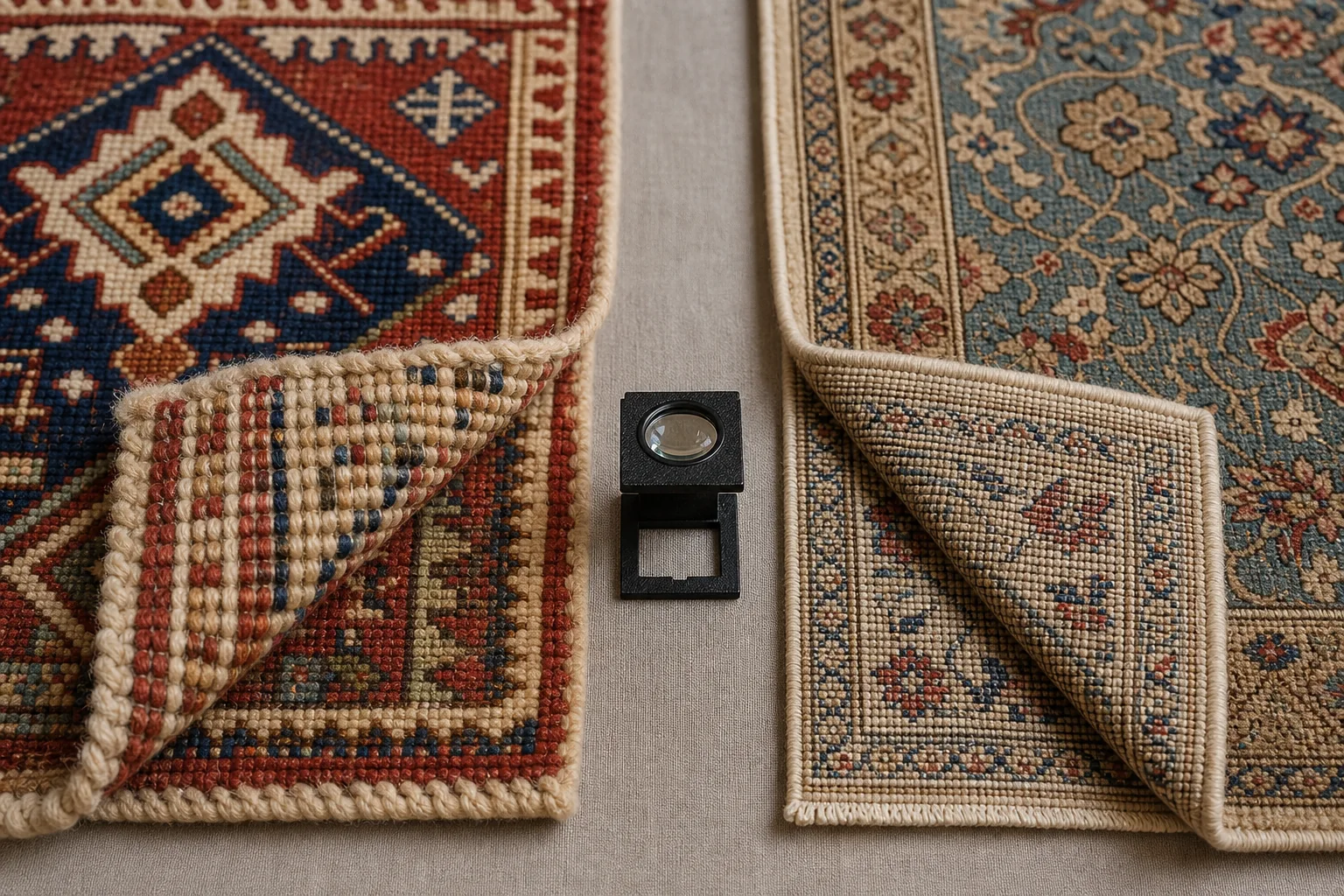
Different densities can serve different artistic aims. A robust geometric rug is not inferior simply because it uses thicker yarn and fewer knots.
How to measure density on the reverse
- Lay the rug reverse-up, or lift only a stable corner if its condition permits.
- Choose a flat, undamaged area away from a repair, distorted edge or strongly rippled section.
- Mark an exact 10 × 10 cm square using a clear gauge or two rulers.
- Count knot columns horizontally and rows vertically. Do not confuse every visible colour node with a complete knot.
- Multiply the two values, then multiply the result by one hundred to obtain an approximate count per square metre.
- Repeat the measurement in several areas and report a range or average.
For example, if a 10 × 10 cm square contains 35 columns and 40 rows, the calculation is 35 × 40 × 100 = approximately 140,000 knots/m². A handmade rug may vary slightly from one area to another.
The units must be comparable
| Notation | What it means | How to use it |
|---|---|---|
| Knots/m² | Total number of knots in one square metre | The clearest metric figure for comparison |
| Knots per 10 × 10 cm | The number in a 100 cm² sample | Multiply the horizontal and vertical values, then by 100 |
| KPSI | Knots per square inch | For a rough conversion to m², multiply by about 1,550 |
| Local unit | A traditional regional count over a defined length | Not directly comparable without the exact length and method |
When comparing offers, always request the unit and measurement method. Some descriptions count visible colour nodes differently, round the figure or convert a local unit without explanation. Two impressive numbers do not mean the same thing if they were not obtained in the same way.
Why several areas should be counted
Hand-knotting may change slightly in width and row density as work progresses. Warp tension, yarn thickness or a change of weaver can introduce small differences that are not automatically faults. One reading from a compressed edge or rewoven section can misrepresent the whole rug.
Wear and repairs complicate historic examples further. A newly reknotted area may have a different density from the original structure. It is better to measure in the field and in another original, well-preserved section and to record where each figure was taken.
What to assess alongside density
| Property | Question to ask | Why it matters |
|---|---|---|
| Pile yarn | Is the wool resilient, cohesive and suited to use? | It affects handle, pile recovery and wear |
| Warp and weft | Is the foundation stable and evenly tensioned? | It maintains shape and distributes load |
| Knot | Is it securely seated and appropriate to the structure? | Fineness is irrelevant if the pile releases easily |
| Pile clipping | Is the height even and suitable for the drawing? | It alters both design clarity and behaviour in use |
| Dyeing | Is the palette balanced and colour stable? | Density says nothing about dye quality |
| Sides and ends | Are they protected, stable and free from unravelling? | Edge damage can spread into the structure |
| Condition | Are repairs, pile loss or distortion present? | Present condition may outweigh original fineness |
Knot density and price
Between two similar new rugs of the same dimensions, materials, origin and design, higher density normally means more knotting and can explain a greater production cost. In actual trade, however, two perfectly equivalent pieces are rarely compared. Differences in materials, age, design authorship, provenance, condition and finishing quality may matter more.
For historic rugs, market value is often shaped by the rarity of the group, artistic quality and degree of survival. A more coarsely knotted but important and well-preserved village rug may attract greater collecting interest than a new rug with an extremely high count.
Choosing density for ordinary use
- Living room: seek a balanced wool structure appropriate to the traffic; the number alone is not decisive.
- Dining room: a stable shorter pile, sound foundation and adequate dimensions for moving chairs matter more.
- Bedroom: lower traffic can accommodate a finer and softer piece if it suits the budget and design.
- Hall and entrance: favour resilient wool, secure edges and a construction suitable for frequent use.
- Formal or collecting area: high fineness may display a complex motif at its best, but needs appropriate protection.
The correct density is the one that serves the design and intended use. A working household rug does not need a record-breaking number; a highly detailed artistic piece cannot realise its purpose on an excessively coarse grid.
Warning signs in a sales description
- The seller gives a high number without a unit or measurement method.
- Density is presented as the only proof of authenticity, origin or age.
- The count comes only from a repaired or unusually compressed area.
- A finer rug is said to be invariably more durable regardless of materials and construction.
- The reverse cannot be examined or the figure checked in several areas.
- The marketing count replaces information about wool, foundation, dyes, edges and condition.
What to take away from the inspection
Use density as a technical description, not a score. It tells you how fine the structural grid is and how much detail the design can carry. It does not by itself tell you whether a rug is authentic, well designed, colourfast, durable or fairly priced.