
Advice and inspiration
Hand-knotted vs. machine-made rugs: what is the difference?

A hand-knotted rug and a machine-made rug can look similar at first glance. Look more closely — especially at the reverse, fringes and pile structure — and the difference becomes clear. The manufacturing method affects more than appearance: it also influences lifespan, repairability, price and whether every piece is genuinely unique.
What does hand-knotted mean?
A hand-knotted rug is made on warp threads stretched across a loom. The weaver ties yarn around individual warp threads one knot at a time. After each row, weft is inserted, the structure is compacted and the pile is gradually trimmed to the desired height.
The knots create both the pile and the pattern. The process requires time, precision and experience. Depending on the rug's size, design and knot density, the work may take many months. Small variations are not defects; they are a natural trace of the maker's hand.
How is a machine-made rug produced?
Machine-made rugs are produced by automated weaving or tufting equipment. The process creates large quantities of nearly identical rugs quickly and with a highly regular structure. Synthetic fibres such as polypropylene or polyester are common, but machines can also process wool. Material alone therefore does not reveal how a rug was made.
The main differences at a glance
| Feature | Hand-knotted rug | Machine-made rug |
|---|---|---|
| Construction | Every knot is tied by hand onto the warp | The pile and pattern are formed by an automated machine |
| Reverse | The pattern is visible and individual knots can be seen | The structure is very regular and may have a covering layer |
| Uniqueness | Every piece has subtle natural variations | Rugs in a production run are nearly identical |
| Lifespan | A well-made rug can last for decades with proper care | Usually intended for short- to medium-term use |
| Repair | Damaged areas can often be professionally re-knotted | Local repair is limited or uneconomical |
| Price | Higher due to time, materials and skilled work | More accessible thanks to fast serial production |
How can you identify a hand-knotted rug?
1. Examine the reverse
On the back of a hand-knotted rug, you can see the same motif as on the front, though the colours appear less vivid. Individual knots and subtle variations are visible up close. The reverse should not be concealed by latex, glue or a rigid textile layer.
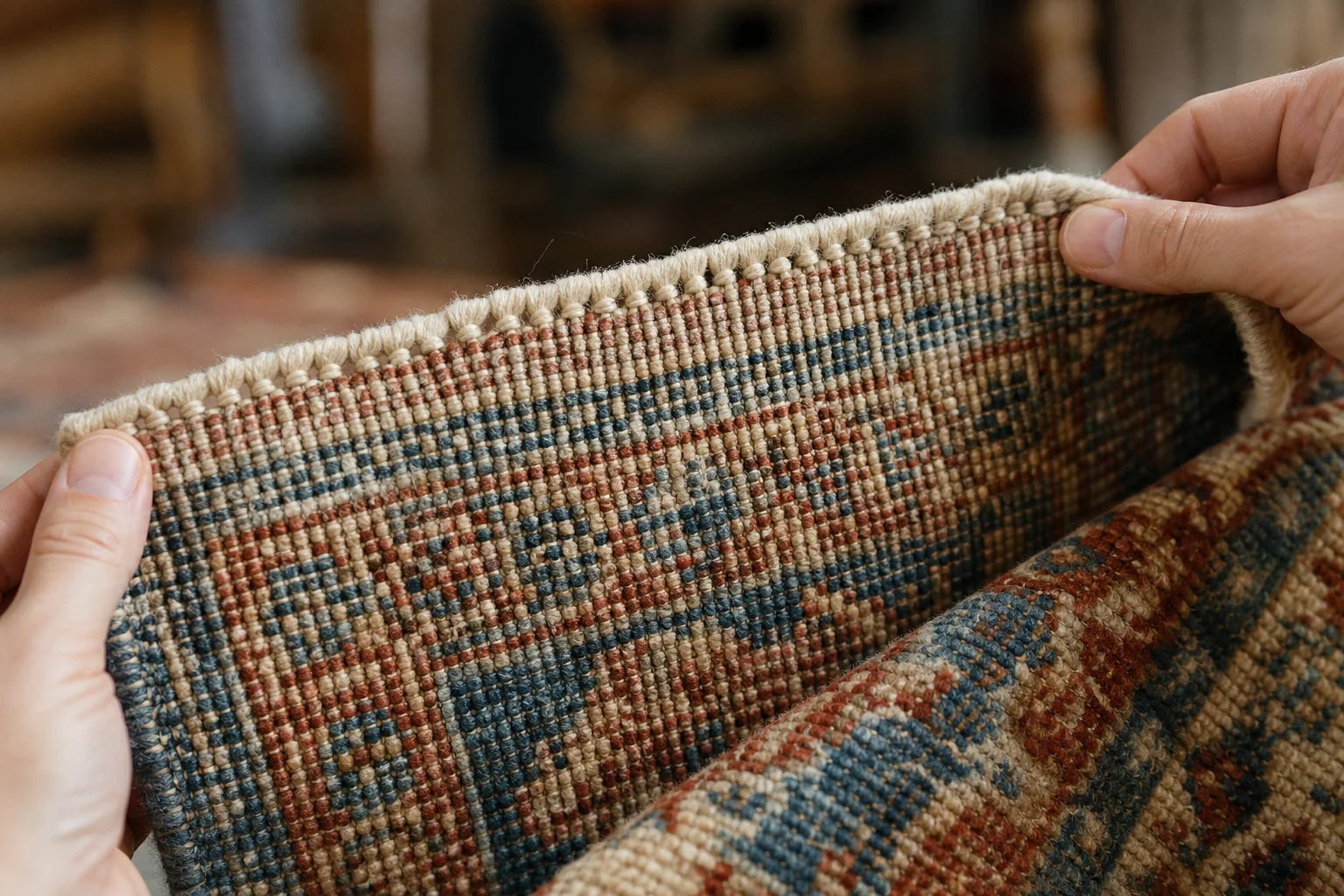
The design remains legible on the reverse of a hand-knotted rug and the individual knots stay visible.
2. Check the fringes
On a traditional hand-knotted rug, the fringes are the ends of the warp threads on which the whole rug was built. They are not simply sewn on as decoration. Some hand-knotted rugs have no visible fringe, however, so always assess this clue together with the reverse and overall construction.
3. Look for natural variation
Handwork is not mechanically perfect. Lines may vary slightly and the pattern may not be absolutely identical on both sides. These subtle differences give the rug character; pronounced distortion or loose knots, by contrast, may indicate damage.
4. Consider the material, but do not rely on it alone
Hand-knotted rugs are most often made from wool, silk or a blend of the two, commonly on a cotton foundation. Machine production can use the same natural materials. Construction, rather than the fibre listed on a label, determines the method.
Hand-knotted is not the same as hand-tufted
The phrase “handmade” can also describe a hand-tufted rug. In that process, yarn is inserted into a foundation cloth with a tufting gun, and adhesive plus a covering layer are usually applied to the back. Production is faster and the result can be attractive, but its construction is not hand-knotted.
Does a higher knot count always mean better quality?
A high knot density allows a finer design and may indicate more demanding work, but it does not determine quality on its own. The quality of the wool or silk, the strength of the weave, dyes, evenness of the pile and harmony of the design all matter. A simpler geometric rug with fewer knots can still be exceptionally durable and valuable.
Which option is right for you?
- A hand-knotted rug is a good choice when you want an original piece for many years, appreciate natural materials and value the possibility of professional cleaning and repair.
- A machine-made rug is a practical option for a tighter budget, a temporary interior or a room where you want to change colours and style more often.
The most important thing is to know what you are buying. A reputable seller will show you both sides, explain the materials, origin and technique, and will not present a hand-tufted rug as hand-knotted.