
Advice and inspiration
What is a Persian rug?

A Persian rug is, in the usual trade sense, a hand-knotted pile rug made in Iran, the country historically known as Persia. The important word is made. A central medallion, floral border or Persian-inspired pattern does not automatically make a rug Persian if it was woven somewhere else.
The name also does not by itself mean that a rug is antique, silk, extremely fine or in perfect condition. Persian rugs can be simple or luxurious, new or old, wool or silk, urban workshop pieces or more rustic village work. A reliable description should therefore say more than “Persian”: origin, material, technique, size, approximate age or period, and condition.
A Persian rug is not one single pattern
Many people imagine a red rug with a central medallion when they hear the phrase Persian rug. That type exists, but it is only a small part of the Iranian rug world. A fine city rug associated with Tabriz, Kashan, Isfahan, Nain or Qom can look very different from a stronger village or nomadic-tradition piece.
Some Persian rugs have precise floral drawing; others use geometric rhythm, scattered motifs, tree-of-life designs, garden layouts or all-over ornament. The difference is not only visual. Pattern often relates to region, workshop practice, material, knot density and whether the rug was intended for daily use, a formal room or a finer collector textile.
How a Persian rug is made
In a hand-knotted rug, individual knots are tied around warp threads. Weft threads are passed between rows of knots to secure the structure. The pile is not glued onto a backing; it grows from the woven textile system. When you turn a corner over, the design should remain legible on the reverse and close inspection should reveal individual points of construction.
Fringe is not merely decoration sewn on at the end. On a genuine hand-knotted rug it is usually the continuation of the warp on which the rug was woven. That is why the reverse, sides and fringe often reveal more than the face alone. They help distinguish hand-knotting from hand-tufting with adhesive, machine production or another construction.
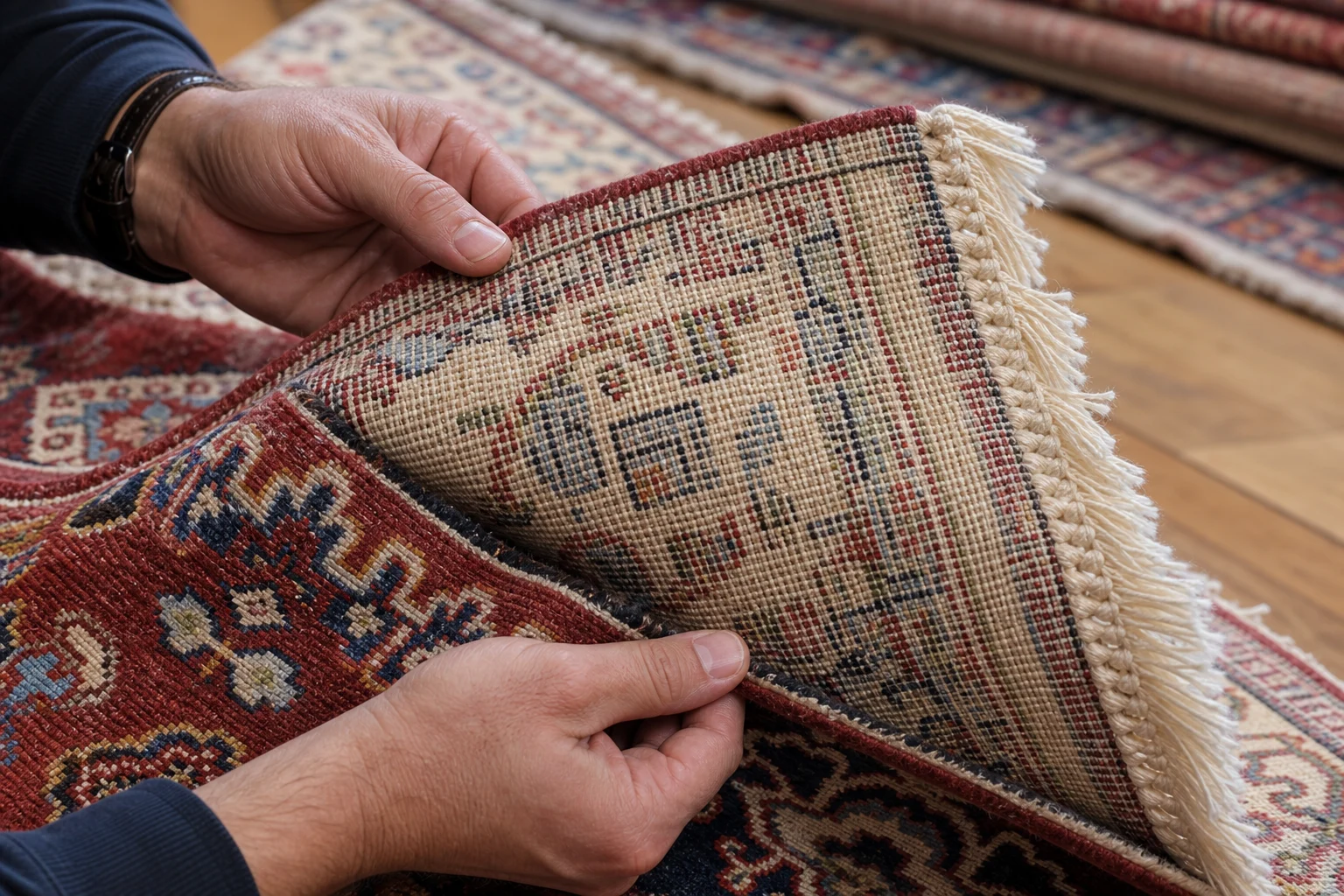
The reverse and fringe help show whether the design is created by actual woven structure or only imitates a traditional Persian look.
Materials: wool, cotton and silk
Wool is the most common pile material. Good carpet wool is resilient, pleasant to touch and has a natural rather than plastic-looking sheen. The foundation may be cotton, wool or, in finer pieces, silk. Silk allows very fine drawing and a distinctive lustre, but it is not automatically the best material for every room.
When buying, do not ask only for one word about “material”. It matters separately what the pile, warp and weft are made from. A wool rug on a cotton foundation behaves differently from an all-wool village rug or a fine silk rug. Material affects touch, durability, drawing, sheen, care and price.
Persian, Persian-style and Oriental rug
These names are often mixed in everyday language. For a serious purchase, it is worth separating them. “Persian” should refer to country of origin. “Persian-style” describes a look inspired by Iranian tradition but not necessarily Iranian manufacture. “Oriental rug” is a broader term and may include handmade rugs from several countries.
| Term | What it usually means | What to watch |
|---|---|---|
| Persian rug | A rug made in Iran, often hand-knotted | The word alone does not prove quality, age or condition |
| Persian-style rug | A design or colour palette inspired by Persian tradition | It may be made in another country and by another technique |
| Oriental rug | A broader group of traditional rugs from different regions | Not every Oriental rug is Persian |
| Machine-made Persian pattern | A machine-made rug with a decorative traditional motif | The appearance does not replace hand-knotting or Iranian origin |
What the word “Persian” does not guarantee
- Handwork without inspection: always look at the reverse and fringe, especially on a surprisingly cheap rug.
- High knot density: Persian rugs exist in many densities depending on type and purpose.
- Silk: many excellent Persian rugs are wool.
- Age or collector value: a new Persian rug can be excellent, but it is not an antique.
- Perfect condition: older pieces must be judged by wear, repairs, edges, stains and dye stability.
How to check origin and quality in practice
Start with a simple inspection. Ask the seller to open the whole rug, not just show a folded corner. Turn part of it over, check whether the design is readable from the reverse, and examine the sides and fringe. Look for adhesive or a separate fabric layer on the back. For a more valuable rug, have the origin, material and condition recorded in writing.
Good questions are specific: In which country and region was the rug made? What are the pile, warp and weft materials? Is the rug new, older or antique? Are there known repairs? Has it been professionally cleaned? What use does the seller recommend? Serious answers should be precise and should not rely on pressure to decide immediately.
Why good Persian rugs are valued
The value of a good Persian rug is not only in its decorative pattern. It lies in handwork, a long textile tradition, quality material, the ability to carry complex drawing through knots, and the fact that a well-made piece can often be repaired and used for a very long time. With older rugs, the individual history and condition of the piece also matter.
The best purchase therefore comes from evidence, not from the name on a label. A Persian rug should be beautiful to you, suitable for the room, clearly described and technically consistent with what you expect from it. When those things work together, the word “Persian” has real meaning.