
Advice and inspiration
What is the difference between a hand-knotted and a hand-woven carpet?

Hand-knotted and hand-woven can sound almost the same, because both can be made by hand on a loom. In practice, however, the two terms often point to different constructions. A hand-knotted rug has individual knots and pile: a soft cut surface made from the yarn ends. A hand-woven rug, in the narrower trade sense, usually means a flatwoven rug without pile, such as a kilim or a similar type.
It is worth knowing that “hand-woven” can also be used broadly. Strictly speaking, a hand-knotted rug is also a textile woven by hand. But when a seller contrasts “hand-knotted” with “hand-woven”, they usually mean the difference between a knotted pile rug and a flat textile without pile. That practical buying situation is what this article explains.
Hand-knotted rug: knots and pile
In a hand-knotted rug, individual knots are tied around warp threads. Weft threads are passed between rows of knots to secure the structure, and the pile is then clipped to the intended height. The result is a rug with body, a softer foot feel and a design made directly from coloured knots.
When you turn the corner of a hand-knotted rug over, the design should still be visible from the reverse. At close range you can see individual points of construction, and the fringe is usually the continuation of the warp on which the rug was made. The back is not covered with glue or a separate stiff fabric layer; the reverse is one of the best ways to understand the real construction.
Hand-woven rug: warp and weft without pile
A flatwoven rug is made by interlacing warp and weft. It does not have separate knots forming a pile, so it is usually thinner, lighter and often reversible or nearly reversible. The design is created by the coloured threads of the woven textile itself, not by rows of clipped knots.
Kilim is a familiar example, but there are other flat techniques as well. Some use simple interlacing, while others use wrapping, brocading or more complex structures. What they share is a flatter surface and a design that belongs to the fabric structure. This type of rug is easier to move, feels more casual and gives an interior a different textile character from a deep pile rug.
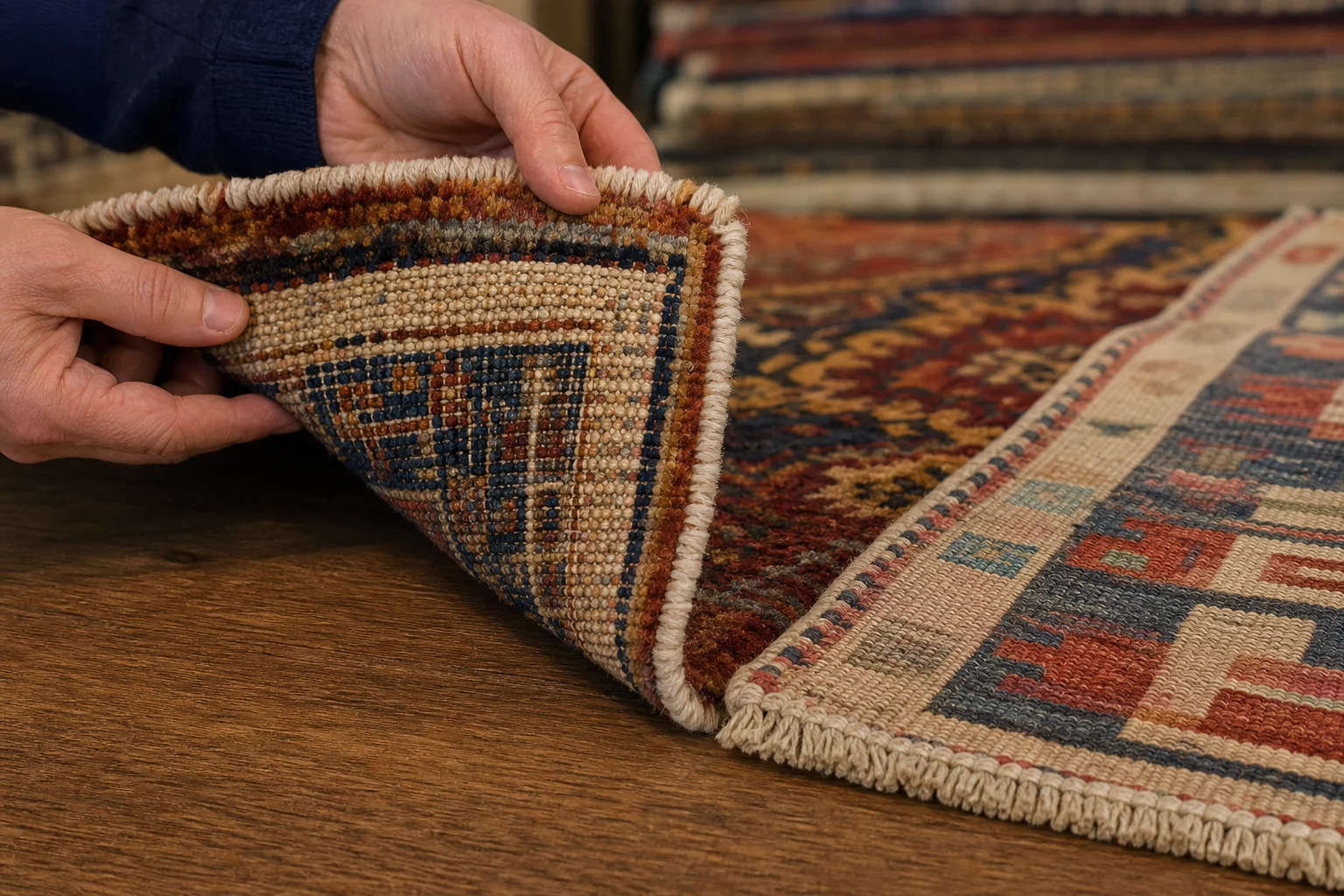
The pile and knotted reverse are visible on one sample, while the other shows a flatter woven structure without a separate pile layer.
The fastest clue is the reverse and the edge
Look at the corner of the rug from the side. A hand-knotted piece has visible pile and more thickness. When it is bent, you can see that the surface and reverse are not two separate layers but one textile structure with knots. A flatwoven rug is usually thinner, more flexible and feels at the edge more like a firm textile than a pile carpet.
The reverse of a hand-knotted rug tends to be more detailed and tells you about the density of the weave. The reverse of a flatwoven rug is often very similar to the face, sometimes with the colours reversed or slightly less crisp. If the back has glue, rubber, a backing cloth or sewn-on decorative fringe, it is neither a pure hand-knotted construction nor an honest flat hand weave.
Practical comparison
| Feature | Hand-knotted rug | Hand-woven / flatwoven rug |
|---|---|---|
| Construction | Individual knots tied on the warp and secured by weft | Warp and weft interlaced without separate pile knots |
| Surface | Soft pile with more volume and depth | Flat surface with the textile structure more visible |
| Thickness | Usually thicker and heavier | Usually thinner and lighter |
| Design | Built from coloured knots and can be very detailed | Built by interlacing threads, often graphic and geometric |
| Foot feel | Softer and warmer | Firmer and flatter |
| Typical use | Living room, bedroom, formal space, long-term value | Dining area, hallway, rug layering, casual interiors, seasonal use |
Which type is more durable?
One type is not always better than the other. A good hand-knotted wool rug can last for decades and can often be repaired locally when treated well. Its pile, however, can hold more fine dust and may be more sensitive to aggressive brushing, long direct sunlight or unsuitable cleaning.
A flatwoven rug can be practical where you want a lower profile, easier handling and a graphic look. Because it has no high pile, it often fits better under doors or dining chairs. On the other hand, a thin construction may show unevenness in the floor, move more easily and feel less comfortable without a suitable underlay.
Which rug suits which room?
For a living room or bedroom where you want softness, colour depth and a sense of luxury, a hand-knotted rug is often the better direction. Pile adds warmth and acoustic softness to a room. If you choose a strong decorative piece, hand-knotting also allows rich drawing and subtle colour transitions.
For a dining area, hallway, kitchen-adjacent zone or a more contemporary interior, a flatwoven rug can be the more interesting choice. It feels lighter, is easier to combine with furniture and often tolerates visually busy everyday use. A proper underlay is important so the rug does not slide and the corners do not lift.
What to ask before buying
- Is the rug hand-knotted, flatwoven, hand-tufted or machine-made?
- What are the pile, warp and weft materials? If there is no pile, what is the main woven textile made from?
- Is the fringe a continuation of the warp, or has it been sewn on later?
- Does the back have glue, a backing cloth or another stabilising layer?
- Is the rug suitable for dining chairs, underfloor heating, children or pets?
- What underlay and cleaning method does the seller recommend?
Be careful with marketing words
“Handmade” can mean different things. Hand-knotted, hand-woven, hand-tufted and hand-finished are not the same. A hand-tufted rug, for example, is made by inserting yarn into a foundation cloth and usually holding the back with adhesive. It may be attractive, but it is not a hand-knotted rug and it ages differently.
If you are unsure, ask to see the reverse, edge and fringe. A serious seller should be able to explain the construction and use precise words. The right choice is not the one with the nicest label, but the one whose construction matches the room, traffic and your expectations.