
Advice and inspiration
Symbols on Persian rugs: what do they really mean?

A Persian rug can be read rather like a picture: first comes the complete composition, then the rhythm of repetition and only then the individual flowers, trees, birds and geometric forms. These elements grew from a long tradition of Persian art, local pattern repertoires, weavers' memory and the requirements of workshops and markets.
They are not a single cipher in which every shape always means the same thing. One motif may have served a decorative, structural, poetic or identifying role at different times. Some popular explanations are reasonable cultural associations; others became widespread only through modern rug trading. When reading a rug, it is therefore more valuable to name a motif accurately, place it in the whole design and acknowledge uncertainty than to attach a quick romantic story.
First rule: a motif is not a dictionary entry
Online lists often say, for example, “a bird means happiness”, “a cypress means eternal life” or “a hook means protection”. Such connections may have support in a particular cultural and regional context, but they are not automatic translations of every image. A weaver may have followed an established pattern, adapted an older cartoon, worked from memory or used a form principally because it filled the space well.
Meaning becomes more precise only when several facts are considered together: where and when the rug was made, whether it came from an urban workshop, village or nomadic setting, where the motif sits, what surrounds it and whether comparable documented pieces survive. Without that context, it is more accurate to describe a possible association than a certain message.
Read the composition before the detail
The overall arrangement often tells us more than a single small sign. A medallion composition concentrates attention in the centre and is commonly balanced by quarter motifs in the corners. An all-over design has no single dominant point; its unit repeats across the field and could theoretically continue beyond the rug's edges.
A directional composition has a definite top and bottom — perhaps a tree, vase or architectural arch. An arch can refer to a prayer niche, but the shape alone does not prove how a particular rug was used. Garden or compartment designs divide the field into paths, watercourses, flower beds or separate panels, translating the idea of an ordered garden into textile.
Observe the relationship between field and borders as well. The edges are not merely a frame: they direct the eye, separate the inner pictorial world from the surrounding space and frequently carry a smaller repeating unit than the main field.
Medallions and corner pieces
A large central medallion is among the most familiar Persian arrangements. It may resemble a star, floral rosette or layered dome, but its principal role is structural: it establishes the centre around which vines, flowers and minor elements are organised.
The celebrated Ardabil Carpet of 1539–40 at the Victoria and Albert Museum shows how sophisticated this system can become. Its enormous yellow medallion is joined by quartered corner pieces, hanging lamps, scrollwork, flowers, leaves and cloud bands in one integrated design. In a work of this kind, no individual element can be removed and allowed to explain the entire composition.
A medallion by itself does not establish a precise origin or date. Successful designs were copied, travelled between workshops and were adapted to different sizes and export markets.
Boteh: shrub, leaf, drop or flame?
The boteh is a curved leaf-like form with a tip leaning to one side. The Persian word denotes a bush or shrub; in the West, the motif became best known through Kashmir shawls and the paisley pattern. On rugs it may stand alone, appear in rows or repeat across an entire field.
Boteh has been described as a cypress, leaf, flame, droplet or a tree bent by wind. These readings can help convey its organic character, but none is a universal key to every example. The sound approach is to name the motif as boteh and frame any further meaning as a hypothesis based on date, region and surrounding design.
Herati, mina khani and Shah Abbasi
Some names identify a complete repeat unit rather than one isolated symbol:
- Herati: a rosette inside a diamond, palmettes at the corners and four curved sickle leaves around it. In Persian the pattern is also called mahi, or “fish”, because the side leaves can resemble small fish.
- Mina khani: a lattice of curving stems with rosettes at their intersections. It is strongly associated with the Varamin area, although many local variations exist.
- Shah Abbasi: a system of large palmettes, blossoms, vines and sometimes cloud bands associated with Safavid court aesthetics and later adopted by numerous urban weaving centres.
These names are useful descriptions of pattern construction, not automatic certificates of origin. Herati was woven across Iran, while traditional Persian designs have also been copied outside the country.
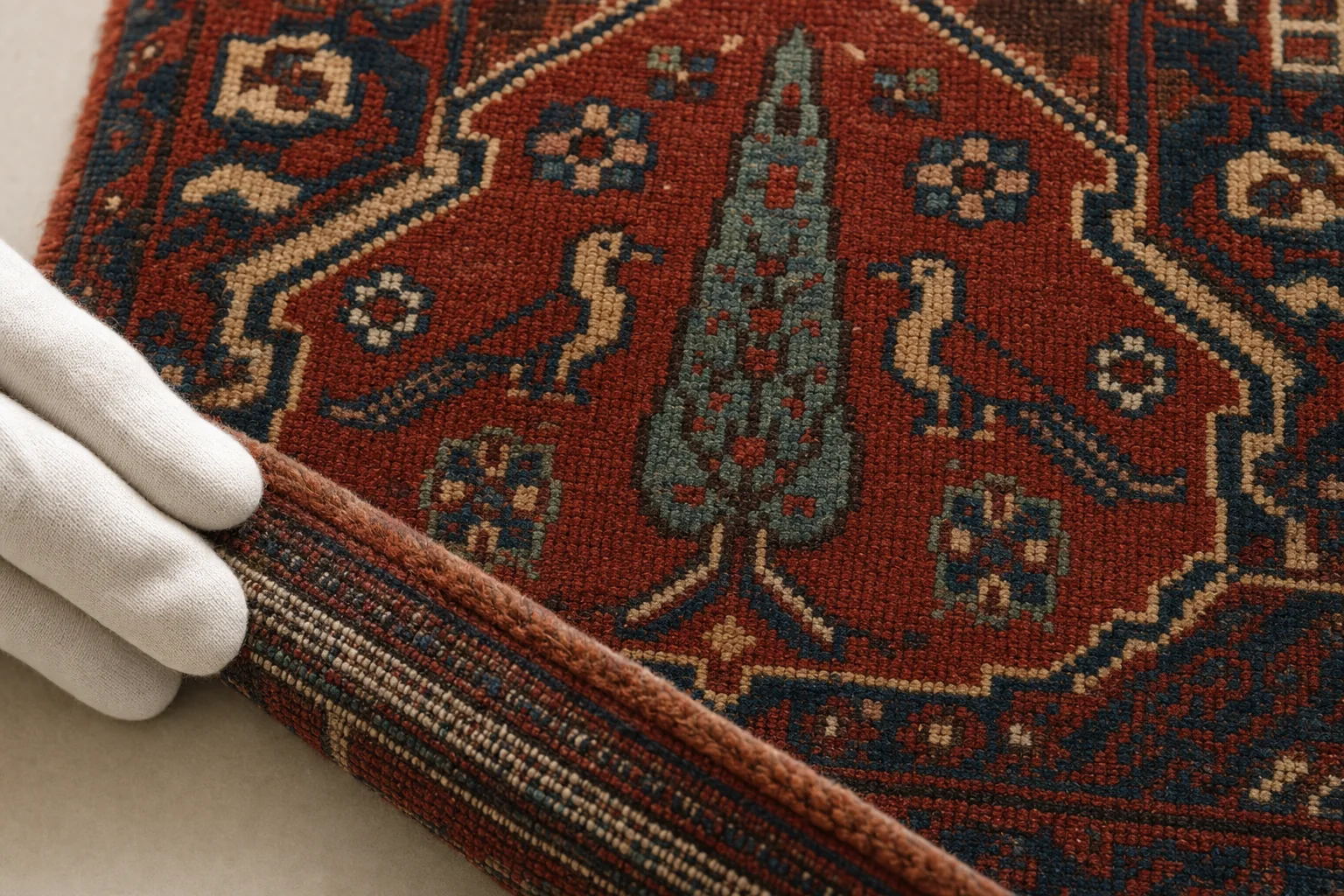
A motif should be read together with its construction. The stylised tree and birds belong to the field's rhythm, while the reverse reveals hand knotting and the drawing's real scale.
Palmettes, rosettes, lotuses and cloud bands
A palmette is a fan-shaped stylised flower or leaf and forms part of the basic vocabulary of Persian carpets. A rosette resembles a flower viewed from above. Both can be so tightly connected to arabesques, vines and other blossoms that rhythmic function matters more than botanical accuracy.
The so-called cloud band is an elongated ribbon-like form ultimately derived from Chinese art and absorbed into Persian ornament. It is a useful reminder that rug designs did not develop in isolation: they travelled with drawings, books, ceramics, textiles and trade.
Names such as “lotus” or “rose” may therefore describe a family of shapes rather than an exactly depicted botanical species.
Tree, cypress, vase and Persian garden
Trees and flowers have strong connections in Persian art with the garden, water, shade and the cultivated paradise. Rugs containing vases, flowering shrubs or fields divided into garden compartments translate this ideal into a surface on which one can walk. Museum terms such as “vase”, “shrub” and “garden carpet” consequently describe a type of composition as well as individual plants.
A tall axial tree is often called a “tree of life” in the trade. It can evoke growth, continuity and a link between earth and sky, but a closer reading depends on the surrounding elements. A stylised cypress can similarly relate to permanence and the Persian garden, yet it is not proof of the original owner's private intention.
On a directional tree rug, look at the roots or vase, crown, birds among the branches and the border. Their relationship reveals whether the tree forms a self-contained picture, a repeated garden unit or part of a larger architectural arrangement.
Birds, animals and hunting scenes
Persian rugs may contain birds, deer, gazelles, lions, horses and fantastic creatures. In courtly hunting carpets they participate in a narrative and relate to royal culture, literature and the garden setting. On a village rug they may be much simpler and incorporated among geometric filler motifs.
A pair of birds around a tree or vase can reinforce symmetry and the life of a garden. It is not safe, however, to assign the same emotion or prediction automatically to every bird. First ask whether the species is identifiable at all and whether the image is simply a highly geometricised space-filler.
A lion can likewise relate in different settings to strength, royal iconography, the zodiac or a particular story. Context always matters more than a generic list of meanings.
Geometric forms, hooks and stars
Diamonds, stars, crosses, octagons, hooks and S forms establish a clear rhythm and translate readily into a knot grid. They sometimes carry traditional protective or group associations; elsewhere they function as borders, connectors or practical fillers between larger elements.
Particular care is needed when moving meanings between cultures. An interpretation documented for an Anatolian kilim or a Caucasian flatweave cannot simply be assigned to a Persian pile rug. A similar shape may have developed independently, bear a different name or result from the geometric simplification of an originally vegetal motif.
Geometry can still be valuable evidence. Its drawing, proportions, colours and relationship to a particular border can help a specialist place a rug within a broader regional tradition.
Inscriptions are a different kind of evidence
An inscription may contain a verse, dedication, signature, workshop name or date. The Ardabil Carpet preserves a poetic inscription, the name Maqsud Kashani and the Islamic-calendar year 946, corresponding to 1539–40. Such text offers a more concrete historical reference than a free interpretation of ornament.
Even here, a quick reading from a photograph is insufficient. Numerals belong to a different calendar, writing may be damaged, added in a repair, woven in reverse or deliberately archaic. On a valuable piece, language and rug-history specialists should confirm the translation and dating. A woven date does not invariably state the year in which the rug itself was made.
Colour is not a universal code
Red, blue, green, yellow and white have rich associations in Persian culture, but a rug colour cannot reliably be translated into a single word. The palette was also shaped by available dyes, local water, recipes, wool, fashion, required contrast and export commissions.
Madder red and indigo are well-known historical colour sources, but a specific dye cannot be identified by eye alone. Ageing, light, washing and separate yarn batches alter the hue. Subtle bands of colour variation called abrash may indicate work with small batches of hand-dyed yarn; they are neither a symbol nor automatically a defect.
What design can reveal about origin — and what it cannot
Certain combinations of motif, drawing and colour are traditionally associated with particular areas and workshops. Heriz is known for geometricised medallions, Varamin for some versions of mina khani, and different groups developed characteristic borders and small filler motifs.
Pattern is not an identity card, however. Successful designs travelled between regions, workshops produced for export, and contemporary manufacture imitates historic models worldwide. Encyclopaedia Iranica notes that a traditional Persian design may now indicate its intended market more clearly than its actual place of manufacture.
A more reliable attribution combines composition with warp and weft materials, knot type, the number and handling of wefts, side and end finishes, pile, dyes, dimensions, condition and documented ownership history.
A quick motif guide
| Motif or pattern | How to recognise it | A sound description | What to avoid |
|---|---|---|---|
| Boteh | Curved leaf or shrub with a leaning tip | Persian motif later known as paisley | Calling every example a flame or cypress |
| Herati / mahi | Rosette in a diamond, palmettes and four sickle leaves | A widely used Persian repeat pattern | Using its name alone to fix the place of manufacture |
| Mina khani | Stem lattice with rosettes at intersections | Floral lattice with regional variants | Treating a trade label as certain provenance |
| Palmette and rosette | Fan-shaped blossom and flower seen from above | Core vegetal vocabulary of ornament | Always seeking an exact botanical species |
| Tree or cypress | Directional trunk and branches, sometimes vase and birds | Motif associated with gardens and growth | Assuming “tree of life” is a precise universal label |
| Birds and animals | Figural forms in a field, garden or hunting scene | Part of a picture, rhythm or narrative | Ignoring species and surrounding context |
| Inscription | Script, numerals or a cartouche | Possible verse, date, signature or dedication | Reading it without expert translation and repair checks |
How to read a particular rug step by step
- Photograph the entire rug square-on. A detail without the whole conceals composition and direction.
- Identify the basic type. Is the design medallion, all-over, directional, garden, compartment or pictorial?
- Separate field from borders. Find the main unit and follow how it repeats or mirrors.
- Name only what you can genuinely recognise. Boteh, herati and palmette are more useful than a generic “mysterious sign”.
- Examine the reverse, sides and ends. Construction places the drawing in a technical and regional context.
- Record inscriptions without correcting them. Do not reshape unclear marks to fit expectations; have them read professionally.
- Seek comparisons in museums and specialist literature. One matching motif is not enough; compare structure, whole design, date and material too.
The most compelling Persian rugs do not need an invented legend. Their real story lies in the relationship between design, material, a weaver's hand, regional tradition and the changes brought by time. Naming a motif accurately is not the end of interpretation — it is the beginning.