
Advice and inspiration
What materials are used to make hand-knotted rugs?

A hand-knotted rug cannot be accurately described with a single material. It has pile, warp and weft, and each part may use a different fibre. The most common combination is wool pile on a cotton warp and weft. Finer rugs may add silk details or use silk throughout their construction, while traditional village and nomadic pieces often employ wool in both pile and foundation.
Material affects handle, sheen, precision of drawing, weight, ageing and appropriate cleaning. It does not determine quality by itself. Fibre grade, preparation, firmness of weave, dyeing and the skill of the weaver matter as well.
First distinguish pile, warp and weft
- Pile: the coloured knots that create the visible surface and design. It is most commonly sheep's wool, silk or a combination of the two.
- Warp: the lengthwise load-bearing threads tensioned on the loom. Knots are tied around them and their ends normally continue as the fringe.
- Weft: the crosswise threads passed between rows of knots. They hold the rows in place and join the warp to form the foundation.
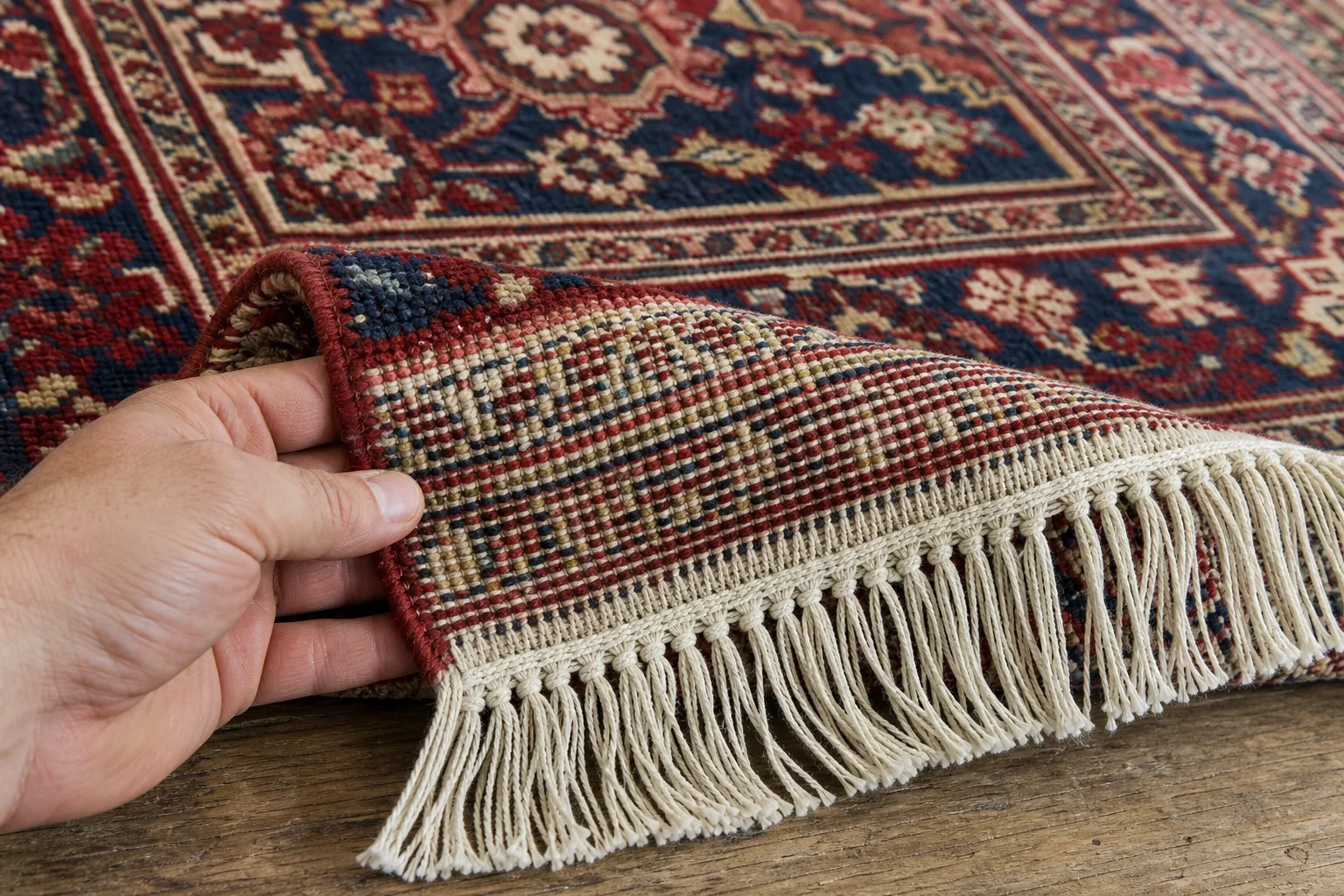
The face shows the pile, the reverse reveals the knotted structure and the end shows warp threads continuing into the fringe.
Sheep's wool: the most common pile material
Wool is the principal fibre of hand-knotted rugs. It accepts dyes well, creates a resilient pile and, when properly selected, tolerates years of use. Its naturally textured surface scatters light more softly than silk, so it usually appears warm and relatively matte, although some wool types have a pronounced natural lustre.
The words “100% wool” do not tell the whole story. Fibre length and strength, cleanliness, yarn consistency, spinning and appropriate pile height all matter. Good yarn recovers when handled, does not feel brittle and does not release an excessive quantity of loose short fibres.
Hand-spun wool has subtle variations in thickness that can animate the surface. Machine-spun yarn is generally more regular. Neither is automatically superior; the right choice depends on the character of the rug and the quality of the execution.
Silk: precise drawing and changing lustre
Silk yarn is extremely fine and strong relative to its diameter. It supports dense construction, exact curves and very small details. Light reflects more directly from its smooth surface, allowing tone and colour intensity to change when the rug is viewed from opposite directions.
Silk can be used in several ways: for the entire pile, for floral and contour highlights within wool pile, or for a very fine warp and weft. An all-silk rug is not simply a wool rug with shiny accents — the pile and foundation materials need to be verified separately.
A fine silk surface calls for more careful placement and specialist cleaning. It generally suits an area with less mechanical wear better than a position beneath frequently moved dining chairs. Silk is not an automatic guarantee of quality either; a poorly executed fine weave remains poorly executed.
Cotton: a stable foundation beneath the knots
Cotton is most often hidden in the warp and weft. It can be tensioned firmly and consistently, helping maintain accurate dimensions and giving city and workshop rugs a regular foundation. In a common wool-pile construction it may therefore be almost invisible on the face but readily visible on the reverse and in the fringe.
Cotton fringes are not a separate decoration. On an accurately described hand-knotted rug they normally continue from the warp. Decorative knots may secure their ends, but the load-bearing threads themselves should connect to the structure of the rug.
Cotton may also form weft in more than one thickness. After each row of pile knots, it is passed between the warp threads and beaten down with a comb, compacting and separating the rows.
Wool warp and weft
Village, tribal and nomadic traditions often use wool not only for pile but for warp and weft as well. An all-wool structure is usually more supple and may have a naturally less regular outline than a city rug tensioned firmly on a cotton foundation.
That variation is not automatically a defect. It can reflect the material, a portable loom and the method of work. It is still important to distinguish handmade character from severe rippling, damaged sides or distortion caused by inappropriate washing.
Other animal fibres
Goat hair appears in some regional rugs and woven objects, for example in firm selvedges, warp or dark structural areas. Camel hair may form small areas of naturally beige or brown pile. Both are far less common than sheep's wool and cannot be identified reliably by colour alone.
Historic court carpets may exceptionally incorporate metal thread wrapped around a silk core. This is a specialised luxury technique rather than an ordinary material for a contemporary floor rug.
Take care with viscose and the term “bamboo silk”
Modern hand-knotted rugs may contain viscose, lyocell or other regenerated cellulose fibres. Terms such as “art silk” and “bamboo silk” do not normally mean true silk produced by the silkworm. These fibres can create a smooth, bright surface but have different performance and cleaning requirements.
This is not a reason to reject them automatically. What matters is accurate description and a suitable room. Ask for the exact fibre content rather than relying on a marketing name.
The most common material combinations
| Construction | Typical character | Suitable use |
|---|---|---|
| Wool pile, cotton foundation | Resilient surface, stable construction and a broad range of fineness | Living rooms, bedrooms and regularly used spaces |
| Wool with silk details, cotton foundation | Wool durability with luminous definition in the design | Representative interiors with moderate traffic |
| Silk pile on a silk foundation | Very fine weave, high detail and pronounced lustre | Quieter settings or collecting |
| Wool pile on a wool foundation | Supple, traditional and often lively irregular construction | Village and tribal types, informal interiors |
How to verify materials when buying
- ask for the pile, warp and weft materials to be stated separately,
- inspect the reverse and fringes — they reveal the foundation, not necessarily the fibre used for the visible pile,
- do not rely on sheen alone; mercerised cotton and regenerated cellulose can resemble silk,
- do not perform a flame or chemical test at home because it may damage the rug,
- for a valuable piece, have the composition, origin and known repairs recorded in writing on the invoice.
Which material is best?
For a frequently used living room, a good wool pile is often a practical choice. Silk or a wool-and-silk combination excels where exceptional detail and changing lustre are the priority. A traditional all-wool rug offers a different character, a softer structure and an authentic drawing style.
The best material is the one that suits the construction, intended use and expected care. When comparing two rugs, do not judge only by percentages on a label. Examine yarn quality, firmness of knots, the reverse, edges, fringes and the overall balance of the piece.